Argorant
Argorant
Alternatives to ZoomInfo

Best ZoomInfo alternatives for B2B contact data.

ZoomInfo now offers both a permanent Lite tier and a broad, AI-native enterprise platform. The alternatives below are for buyers who need more than Lite's 10 monthly credits but do not necessarily need ZoomInfo's full context graph, custom paid package, or annual buying motion.

Reviewed and updated August 20, 2026 by Argorant

The right ZoomInfo alternative depends on what you are actually replacing: a contact database, an enrichment workflow, sales engagement, buyer intent, CRM hygiene, or a complete enterprise GTM platform. Start with the job, then pick the tool.

Before the feature list

What an unspent credit is worth in month six.

Two billing shapes, one allowance, one spend rate. On our plans, credits you did not use are still there later, and a row that turns out to be unreachable is never charged at all.

Unspent credits, carried40 left over each cycle
Cycle 1
2
3
4
5
6
Cycle-expiry model40
Argorant plan credits240

Same allowance, same spend. The only difference is what happens at the cycle boundary.

The shortlist, in the order most teams work through it.

01
Argorant
Published cost per valid contact, export-time verification, and app/API/CLI/MCP access.
Compare

Best when contact data is the job, not one module inside a wider GTM suite. Invalid and unverifiable exports cost zero; standard plans and agent-wallet pricing are public.

02
Apollo
Teams that want contact data and sales engagement in one workflow.

Often evaluated when sequencing and prospecting should live together. Buyers should compare data freshness, verification, and export rules for their target market.

03
Cognism
Teams prioritizing EMEA coverage and enterprise B2B data workflows.

Worth evaluating for European sales motions, compliance posture, and phone-data requirements. Check pricing and package fit directly.

04
Lusha
Smaller teams that need a simpler contact-data product.

Can be a lighter alternative for basic prospecting. Compare credit rules, data freshness, and role coverage before committing.

05
UpLead
Contact search and verification-focused list building.

Relevant when the buyer wants a more focused data product. Test coverage in your target industry and country before scaling.

06
Hunter
Email finding and domain-level research.

A narrower tool for email discovery and verification rather than a broad sales intelligence suite.

07
Clay
Teams orchestrating multiple enrichment sources and custom GTM workflows.

Clay is not a one-for-one database replacement. It is worth testing when the core problem is waterfall enrichment, research logic, and workflow composition across several providers.

08
LeadIQ
SDR capture, browser prospecting, and handoff into existing sales workflows.

A practical shortlist option when reps care more about finding and moving a prospect quickly than about buying a full enterprise intelligence layer.

Pricing snapshot: what ZoomInfo publishes, as of August 20, 2026.

Only the public plan page, quoted as it stands. Terms move, so the review date matters as much as the number.

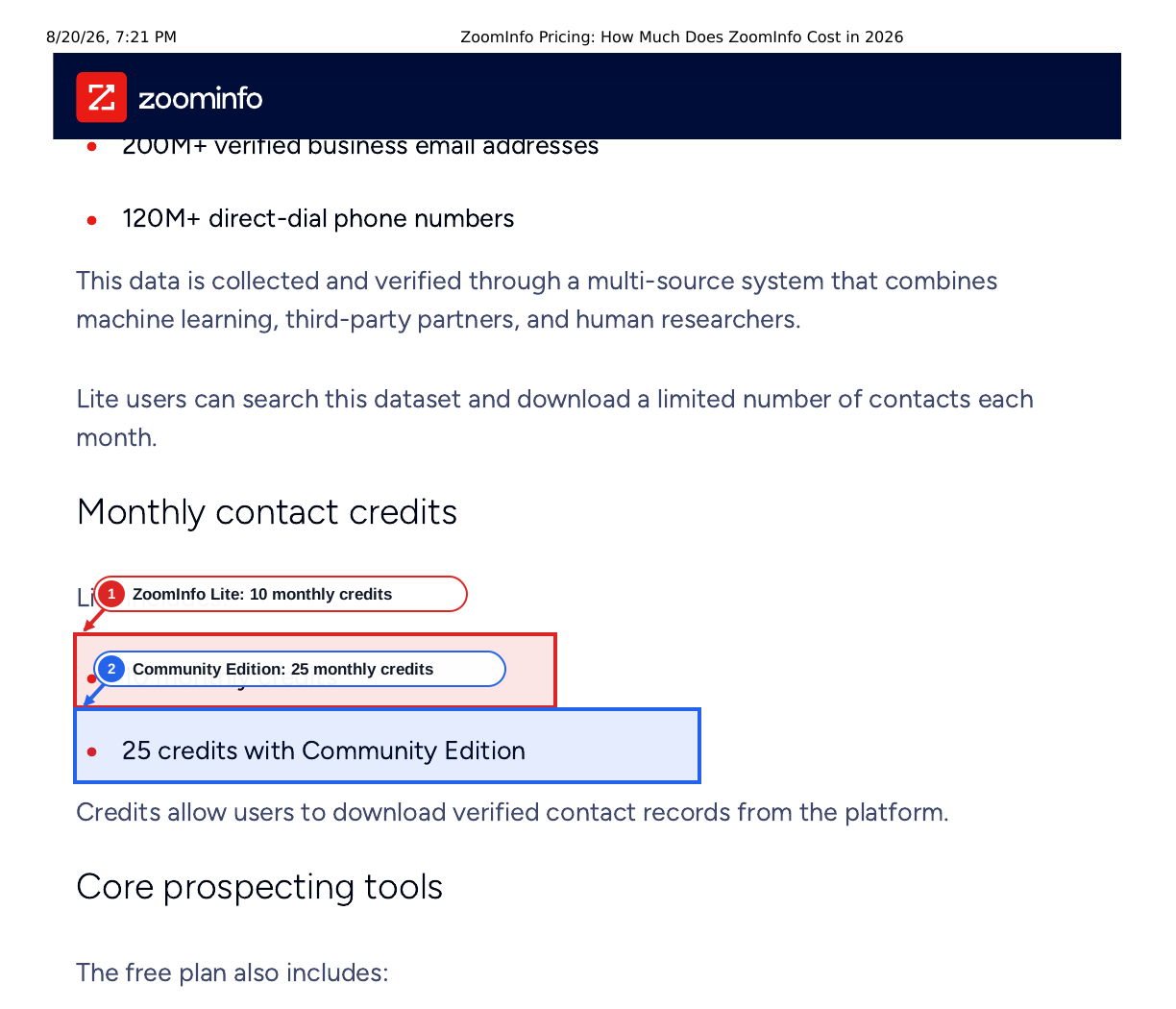
ZoomInfo's 2026 pricing guide with buyer-facing annotations
Source: ZoomInfo's 2026 pricing guide · Captured August 20, 2026
  1. 1
    ZoomInfo Lite: 10 monthly credits

    ZoomInfo's own pricing guide describes Lite as a permanent entry tier with 10 contact-download credits each month.

  2. 2
    Community Edition: 25 monthly credits

    The same guide says contributors to Community Edition receive 25 monthly credits.

ZoomInfo Lite is a permanent free entry tier with 10 monthly credits; Community Edition increases that allowance to 25.

Enterprise plans remain custom-quoted and generally annual; independent ranges annualize to roughly $1,250-$3,750+ per month for a base package and $2,500-$5,000 all-in.

GTM AI starts with 1,000 data and 1,000 AI credits, free search and lookup, and top-ups from $20; the launch data-credit rate is $0.10 versus a stated $0.35 list price.

Lite makes a small same-sample test possible before procurement. Paid buyers should still request users, credit rules, add-ons, API/MCP rights, renewal terms, and cancellation language in writing.

What to compare before switching: five answers to get in writing.

Term
Is the commitment monthly or twelve months, and what happens at renewal?
Price
Is the number published, or does it arrive after a discovery call?
Credits
Do unspent credits survive the cycle, and what does one credit buy?
Access
Are exports, API and agent access included, or priced as add-ons?
Exit
How is cancellation served, and what happens to data already exported?

How to shortlist ZoomInfo alternatives

Do not start with the logo grid. Start with the workflow. If your team needs enterprise account intelligence, enrichment, intent, and multiple departments on one contract, a broad platform may be justified. If the real need is finding verified people and exporting lists, a focused data layer may produce faster payback.

The best evaluation uses a live account sample. Pick 25 companies in your market, define the roles you actually sell to, and test every provider on coverage, email status, duplicate handling, export fields, and workflow speed. The vendor that wins your market sample is more useful than the vendor with the biggest generic database claim.

Pricing questions to ask every vendor

Ask for the full cost before comparing tools: seats, credits, exports, phone numbers, API access, CRM pushes, re-verification, onboarding, renewal uplift, and cancellation terms. If AI agents or automation matter, ask whether those workflows are included or treated as a separate usage category.

ZoomInfo's own filings explain why the contract can become difficult to compare: pricing varies by functionality, users, and the amount of data integrated, while contracts typically run one to three years and are non-cancelable. Independent 2026 guides commonly estimate roughly $15,000 to $45,000+ for base paid packages and around $30,000 to $60,000 all-in after additional seats, credits, and modules. Those are market ranges, not official list prices.

ZoomInfo alternatives can also look cheaper until export limits or add-ons show up. The fairest comparison is cost per usable contact: a record your team can reach, legally use, export, and act on in the workflow you bought the tool for. Put every component of the incumbent quote and every alternative on the same one-year cost sheet.

For a monthly planning view, the estimated $15,000 to $45,000+ base range equals roughly $1,250 to $3,750+ per month, while the $30,000 to $60,000 all-in range equals about $2,500 to $5,000 per month. Those are annualized equivalents, not evidence of a cancellable monthly plan.

The best affordable ZoomInfo alternative depends on the unit you need

“Affordable” is not a vendor category; it is a constraint on a specific workflow. A founder who needs 300 verified work emails, an SDR team that needs data plus sequencing, and a RevOps team that needs CRM enrichment are buying different units. A cheaper seat can still be expensive when phone reveals, exports, API access, verification, or additional users are metered separately.

For transparent self-serve entry, compare Argorant, Apollo, Hunter, Lusha, UpLead, and LeadIQ on the exact plan and billing period you would buy. For an automation-heavy workflow, compare Argorant's no-subscription agent wallet, ZoomInfo GTM AI, Apollo's plan-governed MCP usage, and Clay's orchestration model as separate buying motions. Cognism and ZoomInfo's broader paid platform remain quote-led, so a budget comparison requires a written proposal rather than a guessed list price.

Use one fixed monthly requirement in the test. If you need 1,000 valid work emails, calculate seats, included credits, extra credits, failed-result treatment, verification, API or export access, and the time required to clean the output. The lowest total cost per usable contact is the affordable option for that workflow, even when it does not have the lowest advertised plan price.

ZoomInfo Lite changes the first step, not the scale decision

ZoomInfo Lite removes the need to rely on a demo for the first data-quality check. It is permanent, requires no credit card, and includes 10 monthly credits; Community Edition offers 25 in exchange for participation in ZoomInfo's data-sharing program.

That is enough to inspect a tightly controlled sample, not to feed a normal outbound campaign. Once the requirement is hundreds or thousands of usable contacts, compare the custom paid ZoomInfo proposal against each alternative's full operating cost.

Compare agentic pricing separately

ZoomInfo's GTM AI surface is a different buying motion from a SalesOS-style enterprise contract. It includes 1,000 data credits and 1,000 AI credits at signup, no card, free search and lookup, API/CLI/MCP access, and top-ups from $20. ZoomInfo states a $0.10 launch rate for the first 5,000 data credits versus a $0.35 list price; one data credit buys one profile enrichment, while research uses separate AI credits.

Argorant's prepaid agent wallet costs $0.035 per contact without a subscription. That nominal price is 65% below ZoomInfo's launch rate and 90% below its stated list rate, but the units are not identical. Run the same prompt, enrichment, and export task and compare data credits, AI credits, valid email output, repeat-charge rules, and total spend.

Apollo is different again: connecting its MCP has no additional fee, but the user's normal Apollo plan, permissions, and credits continue to govern enrichment and other metered actions. A serious agentic comparison therefore needs its own column rather than hiding MCP economics inside ordinary seat pricing.

What our multi-verifier export tests found

In Argorant's internal tests, the invalid share in ZoomInfo exports ranged from 31% to 38% across multiple verifiers; one specific result was approximately 34.6%. Apollo exports in the same testing program ranged from 39% to 48%, including one 46.21% result.

The test set used Argorant's built-in verifier and the external services VeriMails, ZeroBounce, DeBounce, and MillionVerifier. Argorant and VeriMails performed equally well in our test; the other three performed worse on these exports. Argorant was slightly more expensive than VeriMails, making VeriMails the lower-cost standalone option of the two top performers. Its current public prepaid rate starts at $0.0019 per verification, with a $0.00025 annual Scale equivalent. Treat that as a first-party observation from our test set, not a universal verifier ranking.

These are first-party observations from the tested exports, not claims about either vendor's whole database. Use them as a reason to test a representative frozen sample before signing a larger contract. Keep valid, invalid, catch-all, and unknown separate, because collapsing those categories can make two verifier reports look more similar than they are.

When to choose Argorant as the alternative

Choose Argorant if you want published pricing, valid-contact economics, export-time verification, and the same focused data actions through the app, API, CLI, or MCP. It is not trying to replace every GTM module.

That makes it a practical ZoomInfo alternative for teams that do not want a heavy procurement cycle, do not need a full enterprise suite, or want AI-assisted prospecting to become a normal part of how lists are built.

Frequently asked

What is the best ZoomInfo alternative?

There is no universal winner. Argorant is the direct choice for published valid-contact economics and agent-ready exports; Apollo for data plus engagement; Cognism for EMEA-heavy enterprise workflows; Clay for multi-provider orchestration; Hunter for email-first discovery.

Why do teams look for ZoomInfo alternatives?

Lite is transparent, but higher-volume paid packaging remains custom, generally annual, and can combine platform access, seats, credits, and add-ons. Buyers also compare alternatives when they need a narrower workflow, different valid-contact economics, another regional strength, or less contract surface.

What is the cheapest ZoomInfo alternative?

There is no honest universal answer because the products meter different units. For a small valid-email export, compare transparent self-serve plans and pay-per-use options on cost per usable contact. For sequencing, enrichment, phones, or CRM automation, include those workflow costs before calling a plan cheaper.

How should I compare data quality?

Use your own target-account sample. Test role coverage, email status, catch-all handling, duplicate records, export fields, and how many records remain usable after verification.

Should I replace ZoomInfo or supplement it?

If ZoomInfo powers multiple enterprise workflows, supplementing may be safer. If you mostly use it for contact lookup and exports, a focused alternative can replace more of the workflow.

Pages reviewed

ZoomInfo pricing pageOfficial pricing entry point; buyers should verify current package and contract details directly with ZoomInfo.ZoomInfo 2026 pricing guideOfficial explanation of ZoomInfo Lite, monthly credits, custom paid pricing, annual billing, credit usage, add-ons, and renewal questions.ZoomInfo LiteOfficial permanent free entry offer for small teams evaluating ZoomInfo contact and company data.ZoomInfo MCPOfficial agent-access page covering OAuth connectors, account and contact tools, enrichment, research, and MCP-compatible clients.ZoomInfo GTM AI pricingOfficial agentic pricing page covering free search, 1,000 introductory data and AI credits, pay-as-you-go top-ups, data-credit and AI-credit mechanics, and enterprise volume pricing.ZoomInfo 2025 Annual ReportCompany-filed description of ZoomInfo's platform, subscription model, and business context.Cleanlist ZoomInfo pricing guideThird-party 2026 pricing estimate reporting roughly $14,995 to $39,995+ base tiers and a $30,000 to $60,000 common all-in range after seats and add-ons; directional only, not an official ZoomInfo price list.Landbase ZoomInfo pricing guideIndependent 2026 reconstruction reporting an estimated $14,995 to $45,000+ annual paid range before extra seats, premium add-ons, and credit expansion; figures must be confirmed in a buyer's quote.Costbench ZoomInfo SalesOS pricingThird-party 2026 estimate and purchase-data summary for ZoomInfo SalesOS.VeriMails pricingPublic verifier pricing used to contextualize Argorant's historical multi-verifier export tests. Argorant's built-in verifier and the external verifier VeriMails performed equally well; Argorant was slightly more expensive. This remains an explicitly first-party observation.

Test it on the segment you actually sell into.

Counting a market is free. You only spend a credit on a contact that came back deliverable.

Loved by revenue teams
We've gotten 16.81% in replies after working with you guys. Can only recommend you.
Jannik Linke, Founder & CEO, Clementine Media · Germany