LeadIQ vs Argorant
LeadIQ is a prospecting workflow product built around capturing contacts, enriching CRM data, finding emails and mobile numbers, tracking signals, and helping reps write outbound messages. Argorant is the focused alternative for teams that want verified B2B contact data, privacy-first company pages, cleaner export controls, API access, and OAuth-protected MCP workflows.
Choose LeadIQ when your reps want a browser-first prospecting hub with contact capture, CRM handoff, signals, enrichment, and AI message writing in the same workflow. Choose Argorant when the primary job is verified contact data as a clean data layer: masked coverage previews, signed-in reveal contacts, export lists, API access, and AI-agent workflows with plan limits and masking.
Argorant is strongest when browser lookup is only the first step and the team mainly needs verified contacts, company coverage, exports, and programmatic access.
LeadIQ is stronger when reps want to capture prospects directly from Chrome and push them into tools like CRM or sales-engagement systems.
Evaluate Argorant by verified contacts, reveal and export limits, API/MCP rights, and cost per usable exported record.
LeadIQ publishes a clear credit model: public pricing describes email, phone number, email plus phone, and account-enrichment credit costs.
Argorant is the better fit when the buyer already has a CRM, sender, sequencer, or agent workflow and mainly needs reliable people data.
LeadIQ is the better fit when the buyer wants prospecting capture, enrichment, signals, and outbound writing packaged as a daily SDR workflow.
Argorant competes on a focused data-layer MCP with masked previews, masking, plan limits, export caps, and admin controls before reveal and export.
LeadIQ already offers a hosted Claude MCP connector and public API documentation; buyers should verify paid-plan requirements, credit usage, and rate limits.
| Area | Argorant | LeadIQ | Buyer note |
|---|---|---|---|
| Product center | Verified contact data, company intelligence, email-format pages, exports, API/MCP access, and account-controlled reveal | Prospecting hub, Chrome extension, contact capture, CRM enrichment, signals, and AI outbound message writing | This is a workflow choice. LeadIQ bundles prospecting actions around the rep. Argorant focuses on the data layer those workflows consume. |
| Pricing model | Public entry plans with account-controlled reveal contacts, export lists, API access, and MCP access | Free, Pro, and Enterprise packaging with credits; official pricing currently shows email, phone, email plus phone, and account-enrichment credit costs | Compare cost per usable contact after credit burn, not only monthly seat price. |
| Public pages | Aggregate coverage, sample contact examples, masked previews, company pages, email-format pages, org-chart pages, and no public full contact records | Public company and email-format pages answer account-research questions | Both can use public discovery. Argorant's line should be stricter: previews publicly, real contact details only after sign-in. |
| API and automation | Hosted MCP/API access with masked previews, masking, plan limits, export caps, and admin controls | Hosted Claude MCP plus official GraphQL API docs describing people and company queries, API keys, credits, and free versus paid rate limits | LeadIQ is credible on MCP. Argorant's differentiator should be the narrower verified-data layer and stricter public-to-private reveal boundary. |
| Best buyer fit | Founders, agencies, GTM engineers, RevOps, AI SDR builders, and teams that want contact data to feed existing systems | SDR teams that want a capture-and-handoff workflow with extension, enrichment, signals, and writing help | Neither positioning has to be stretched. The right choice depends on whether the buyer wants a workflow app or data infrastructure. |
Public Free, Starter, Pro, and Scale plan structure, with reveal, export, API, and MCP behavior controlled by account permissions and plan limits.
Evaluate Argorant by verified contacts, aggregate company depth, export quality, API/MCP fit, and whether it avoids forcing reps into another sales workflow app.
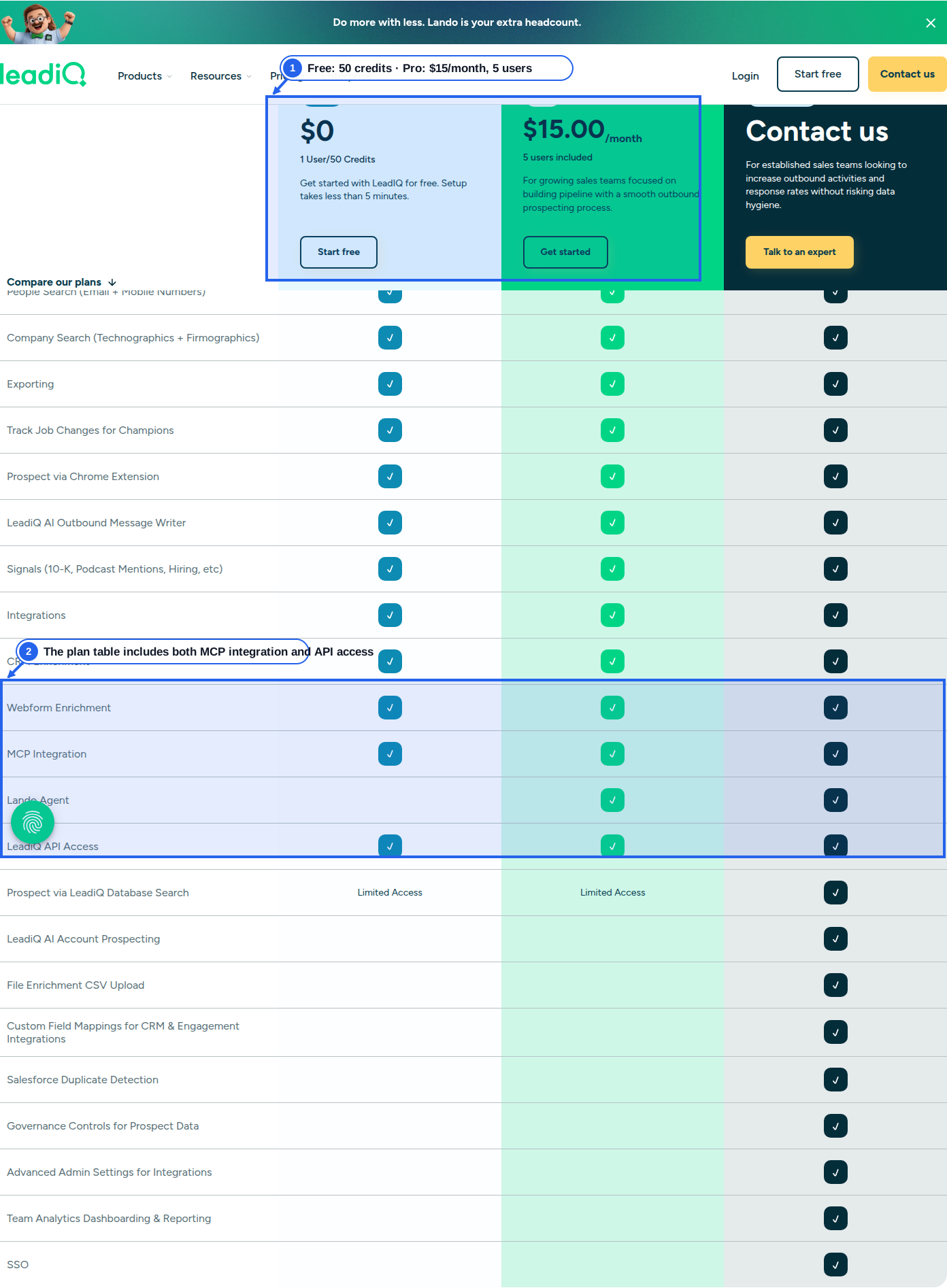
Official pricing currently shows Free, Pro, and Enterprise options, a credit slider, monthly and annual billing, and credit costs for email, phone number, email plus phone, and account enrichment.
Ask how shared team credits work, which actions consume credits, whether API usage is included for the intended workflow, what rate limits apply, and whether mobile-number usage changes the economics.
Plan pages and quote terms can change by billing cycle, seats, credits, and add-ons. Use this section to compare public details and the questions worth confirming before you commit.

LeadIQ is moving toward a credit-slider model with enterprise quoting. Buyers should verify monthly credits, users, phone costs, API access, Claude connector access, and annual terms.
Good if the team likes LeadIQ's prospecting workflow and Claude positioning. Argorant competes on broader data volume, transparent reveal/export rules, and higher AI-agent usage ceilings.
Higher-volume plans can be scoped around seats, exports, API access, MCP usage, and admin controls instead of forcing a full sales-intelligence suite.
Best when the buyer wants transparent limits, high-volume contact search, export controls, and AI-agent access without a quote-only starting point.
A pricing page is only the first screen. Real cost shows up when seats, credits, exports, automation, and renewal language interact.
Minimum users, admin seats, and paid workspace members.
Email, phone, enrichment, API, and AI-agent usage rules.
CSV, CRM push, list download, and re-export limits.
API, MCP, browser extension, and workflow permissions.
Annual term, cancellation, uplift, and overage language.
LeadIQ versus Argorant is not simply a database-size comparison. LeadIQ is built for the rep's daily prospecting flow: capture contacts from the browser, see account context, enrich CRM data, track sales triggers, and generate outbound copy with AI. That can be valuable when the team wants a workflow product around the SDR.
Argorant is a cleaner fit when the team already has the workflow layer and wants the contact-data layer to be stronger. The product direction is to show company coverage, email-format patterns, org-chart signals, and role depth publicly, then move contact details, verification, exports, API, and MCP usage behind account controls.
LeadIQ deserves credit for making its public pricing easier to inspect than many enterprise sales-intelligence vendors. Its pricing page explains a credit model and shows how email, phone number, email plus phone, and account enrichment consume different amounts of usage. That transparency is useful, but teams still need to forecast their real monthly burn.
The relevant model is cost per usable exported contact. A team that needs many mobile numbers will consume credits differently from a team that mainly needs verified work emails. A team that uses API calls or automation will consume usage differently from a rep who clicks through a small number of accounts manually.
LeadIQ is stronger when a buyer wants a packaged prospecting workflow. The official extension page positions LeadIQ around finding prospects, contact data, account details, CRM and sales-stack status, and next-step actions without making the seller jump between tools.
LeadIQ also has official API documentation, a hosted Claude MCP connector, and clear plan language around people search, mobile numbers, CRM enrichment, signals, integrations, and AI outbound writing. If those features sit directly in the rep workflow, LeadIQ can be more operationally complete than a narrow contact-data tool.
Argorant is stronger when the buyer wants verified contacts to feed several systems instead of another daily prospecting workspace. That matters for founders, agencies, GTM engineers, RevOps teams, and AI SDR builders who already have a CRM, sending stack, enrichment chain, or custom agent workflow.
The discovery layer should also be safer. Argorant can publish company pages, email-format pages, org-chart pages, comparison guides, and free tools while using sample contact examples, aggregate counts, and masked previews. Real people, full email addresses, phone numbers, exports, and automated reveal belong after sign-in and plan limits.
Run the same test in both products: 25 target companies, three buyer titles, two countries, and one export destination. In LeadIQ, test Chrome capture, database search, CRM push, mobile availability, credit consumption, API rights, and signal usefulness. In Argorant, test company coverage, email-format pages, org-chart coverage, verified email output, export fields, API/MCP behavior, and signed-in reveal controls.
Then compare the output that actually reaches your workflow. Count relevant contacts found, verified emails, stale titles, duplicate people, mobile availability, export fields, manual cleanup, and total credits or plan cost. The winner is the vendor that produces more usable records for the job you actually run.
AI changes the buying criteria because agents can search, preview, enrich, and prepare account lists much faster than humans can click. A normal SDR workflow may tolerate fuzzy limits. An agent workflow needs explicit OAuth, plan limit, masking, reveal contacts, export lists, and owner and admin controls.
LeadIQ already has a Claude MCP connector, and its public page says the integration uses existing LeadIQ credits. That makes the diligence concrete: confirm paid-plan requirements, credit behavior, rate limits, and permitted automation patterns. Argorant leans into a different agent posture: masked previews, OAuth-protected MCP, account-level plan limits, export caps, and admin controls for owners.
LeadIQ is better when the team wants a Chrome-first prospecting workflow with capture, CRM enrichment, signals, and AI outbound writing. Argorant is better when the job is verified contact data, company intelligence, clean exports, API access, and OAuth-protected MCP workflows.
Yes. LeadIQ publishes Free, Pro, and Enterprise packaging, a credit slider, monthly and annual billing, and credit costs for different data actions. Buyers should still verify the current plan view and forecast credit burn on their own account sample.
LeadIQ is the stronger fit for browser-first prospect capture. Evaluate Argorant when the browser workflow is less important than verified contact data, exports, API access, and AI-agent usage.
LeadIQ is already credible for Claude-based prospecting because it offers a hosted MCP connector. Argorant is the stronger fit when the workflow needs a focused verified-contact data layer, masked previews, masking, plan limits, export caps, and admin controls before reveal.
Official pricing page showing Free, Pro, and Enterprise packaging, monthly/annual billing, credit mechanics, API access, enrichment, integrations, and AI outbound features.
Official extension positioning around finding prospects, contact data, account details, CRM status, and outbound handoff from the browser.
Official help article describing the LeadIQ Prospecting Hub Chrome extension, side-panel behavior, and install workflow.
Official MCP connector page describing LeadIQ's Claude setup, hosted MCP URL, OAuth login, paid subscription requirement, credit usage, and natural-language prospecting workflows.
Official API documentation covering GraphQL access, people and company queries, API keys, free and paid rate limits, credits, and error handling.
Third-party 2026 pricing guide. Useful for buyer diligence around credit and seat economics, but buyers should verify current LeadIQ pricing directly.
Third-party 2026 pricing summary. Treat plan details as directional and confirm the current billing view or quote before committing.
Search verified contacts, check coverage, and export a clean list before deciding which platform belongs in your stack.
Start free