B2B data providers, compared honestly.
Every vendor claims the biggest database and the best accuracy. Both claims are unfalsifiable as stated. Here’s a framework that replaces them with questions you can actually test, including on us.
By Argorant
Reviewed and updated August 20, 2026 by Argorant
Why headline numbers mislead
The category sorts itself by total record count: ZoomInfo and Apollo each advertise databases in the hundreds of millions, Cognism leads with European depth, Lusha and Hunter with simplicity, and Argorant’s own number is 626.5M contacts across 202 countries. None of these figures, including ours, answers the question you’re actually asking: whether the database covers the eight thousand companies yousell to, with mailboxes that still exist. A vendor can lead a global count and be thin in mid-market German manufacturing; a smaller database can be dense exactly where you operate. Total size tells you about the vendor’s collection ambitions, not your hit rate.
So the first rule of evaluation: ignore the brochure and test coverage against your real market. The rest of this guide is the checklist for doing that, in the order the questions matter.
Current pricing and access map
A useful comparison needs the monthly price, the annual monthly equivalent, the included usage, and the programmatic-access rule. The snapshots below were checked on August 20, 2026. They are not affiliate summaries. Each card links to the vendor page used.
- Free 14-day trial with 100 credits, no card needed.
- Starter: $99/month, or $79/month billed annually (5,000 contacts).
- Pro: $249/month, or $199/month billed annually (25,000 contacts).
Best when the buyer wants transparent limits, high-volume contact search, export controls, and AI-agent access without a quote-only starting point.
- Free plan: $0 with 900 credits per seat per year.
- Basic: $65 month-to-month with 2,500 monthly credits, or $49 per seat/month billed annually with 30,000 annual credits.
- Professional: $99 month-to-month with 4,000 monthly credits, or $79 per seat/month billed annually with 48,000 annual credits.
Best when the team wants prospecting data and outbound workflow in one workspace. Less focused if the buyer only needs verified data and flexible export or MCP usage.
- Free includes 50 credits per month and unlimited users.
- Starter: $49 month-to-month for 2,000 monthly credits, or $34 monthly equivalent with 24,000 annual credits.
- Growth: $149 month-to-month for 10,000 monthly credits, or $104 monthly equivalent with 120,000 annual credits.
Best when email discovery and verification are the main job. Argorant is stronger when company intelligence, contact depth, exports, and agent usage matter more.
- Free includes 40 monthly credits. Annual billing lists Starter at $37.45/month for 4,800 annual credits, Pro at $48.95 for 7,200, and Premium at $259.95 for 40,800.
- Month-to-month list prices are $49.90 for Starter, $69.90 for Pro, and $399.90 for Premium; Scale remains custom.
- One verified email costs 1 credit, a phone costs 5, and CSV/API result batches of 1-25 rows cost 1 credit under the published rules.
Compare the same workflow across email, phone, API, CSV, and AI actions. A single balance is simple, but the cost per useful output changes sharply when a phone costs five times an email.
- Free trial: $0 for 7 days with 5 credits.
- Essentials: $99 month-to-month for 170 monthly credits, or $74 monthly equivalent with 2,040 annual credits.
- Plus: $199 month-to-month for 400 monthly credits, or $149 monthly equivalent with 4,800 annual credits.
Buyers should compare credits, additional-credit pricing, verified phones, API access, and export workflows against Argorant's higher-volume contact use cases.
- Free: $0 for one user with 50 credits.
- At the minimum 200-credit monthly setting, Pro is $20 month-to-month or $15/month billed annually for 2,400 annual credits, with up to five users.
- The live slider reaches 6,750 monthly credits at $290.25 month-to-month or $217.69/month billed annually; Enterprise remains custom and annual-only.
Good if the team wants LeadIQ's rep workflow and Claude connector. Compare cost per usable output because the slider price changes with credits and MCP uses the same authenticated plan balance.
- Essentials: $33/month equivalent, $399 billed annually, with 100 monthly lookups and email-only data.
- Pro: $75/month equivalent, $899 billed annually, with 250 monthly lookups and email plus phone.
- Ultimate: $142/month equivalent, $1,699 billed annually, with 1,000 monthly lookups, email plus phone, and API access.
Strong public discovery surface and browser workflows. Buyers should compare annual export limits, lookup add-ons, mobile access, and team billing against Argorant's higher-volume needs.
- ZoomInfo Lite is a permanent free entry tier with 10 monthly credits; Community Edition increases that allowance to 25.
- Enterprise plans remain custom-quoted and generally annual; independent ranges annualize to roughly $1,250-$3,750+ per month for a base package and $2,500-$5,000 all-in.
- GTM AI starts with 1,000 data and 1,000 AI credits, free search and lookup, and top-ups from $20; the launch data-credit rate is $0.10 versus a stated $0.35 list price.
Strong for broad GTM intelligence and integrated signals. Lite's 10-credit monthly allowance is a test path, not a high-volume operating plan.
- Standard and Pro each include five seats but are described without public dollar prices.
- CRM enrichment and Data-as-a-Service are positioned as add-ons or separate buying motions.
- One credit reveals, enriches, or exports one contact; the same credits work across the platform, Enrich, and API.
Strong for enterprise teams that value EMEA coverage and managed buying. Argorant is stronger when transparent data access, high-volume exports, and agent-native workflows matter most.
What the published plan pages actually show
Screenshots are useful only when the highlighted claim is visible and the live source is linked. These two examples show why the sticker price alone is insufficient: UpLead moves full API access into an annual custom plan, while LeadIQ publishes both MCP and API access but says its Claude connector consumes normal paid-plan credits.
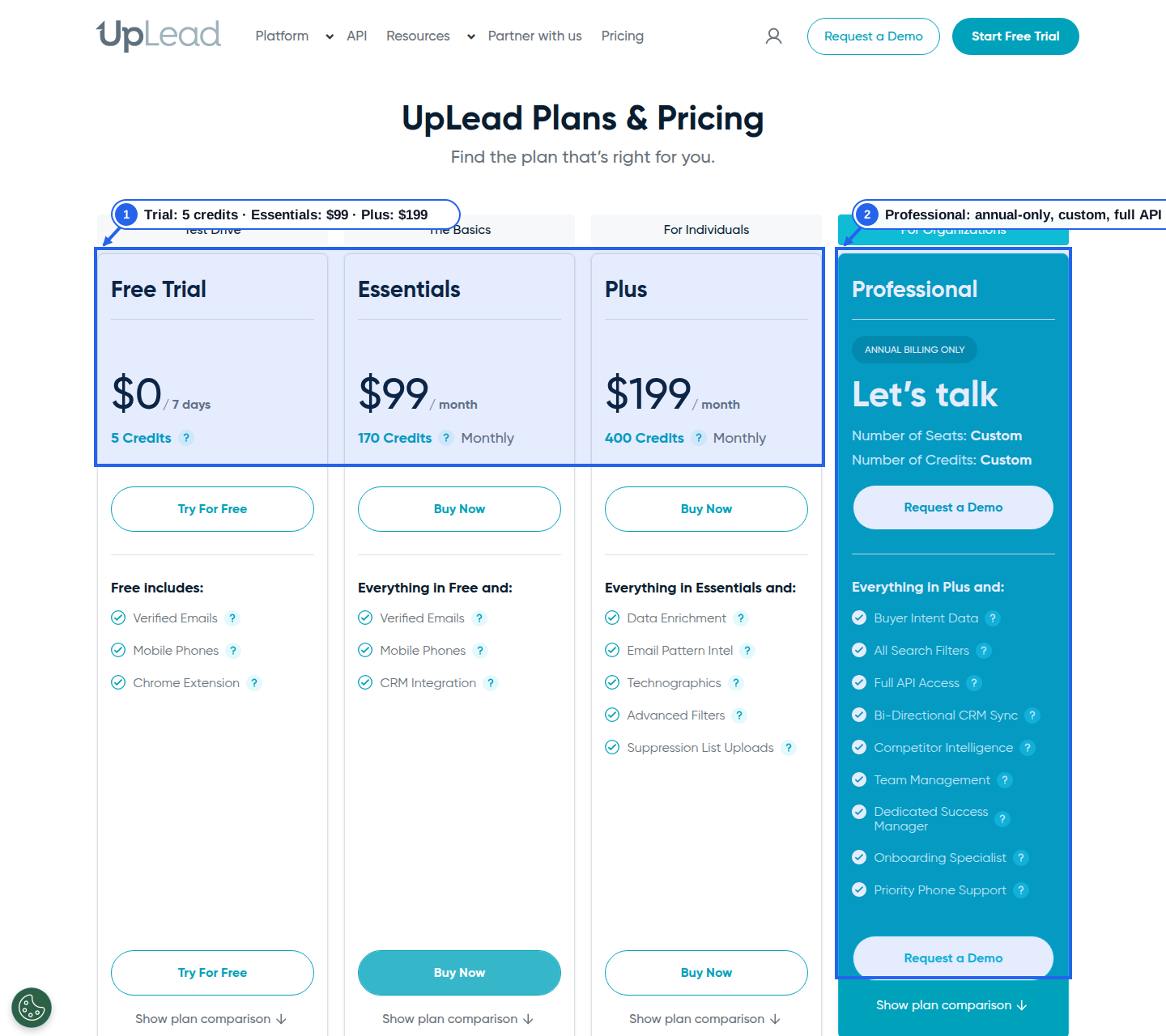
- 1Trial: 5 credits · Essentials: $99 · Plus: $199
UpLead's monthly view shows a seven-day five-credit trial, Essentials at $99 for 170 monthly credits, and Plus at $199 for 400 monthly credits.
- 2Professional: annual-only, custom, full API
The Professional card is annual-only, uses custom seats and credits, and lists full API access.
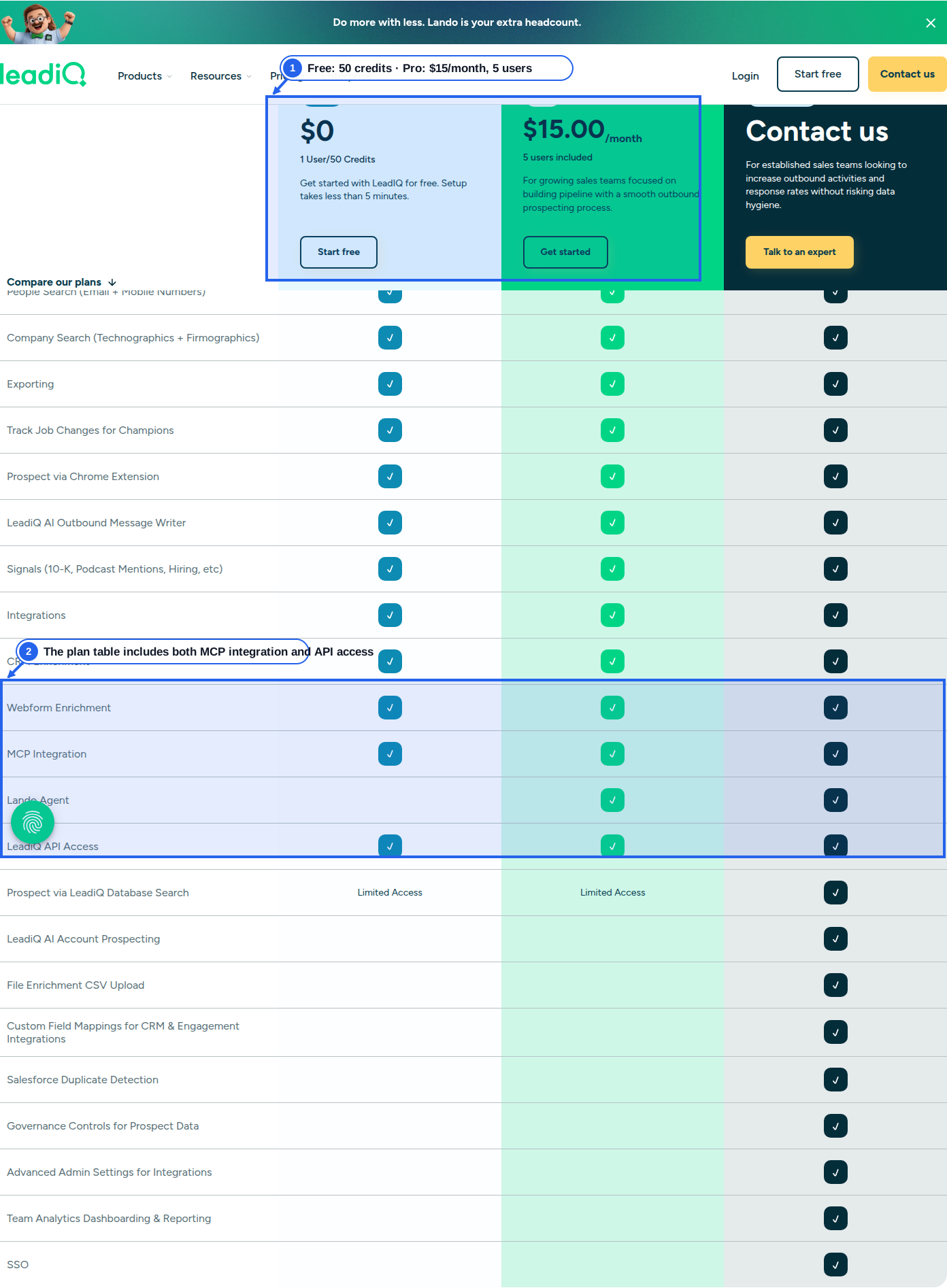
- 1Free: 50 credits · Pro: $15/month, 5 users
In the selected annual view, Free includes one user and 50 credits while the minimum Pro setting shows $15 per month and up to five users.
- 2The plan table includes both MCP integration and API access
LeadIQ's public comparison table lists MCP integration and API access; separate Claude documentation says live company and contact access requires an active paid subscription and consumes normal credits.
1. Coverage against your actual ICP
Take your genuine ICP filters, including industry, headcount, geography, and title, and run the identical search in every platform you’re evaluating, on a trial or free tier, before any contract discussion. Record three numbers: matching companies, matching contacts with emails, and (by sampling) how many of those companies are really in your segment versus misclassified. Then check ten accounts you know well, including current customers and dream logos, and see whether the right people show up at each. An afternoon of this produces a coverage table no analyst report can give you, because no analyst has your ICP. Geography deserves special attention: providers differ far more outside the US than inside it, and EU/DACH/APAC depth varies enormously between vendors that look identical on a US-only test.
2. Verification methodology and timing
“95%+ accuracy” appears on nearly every site in the category and means nothing without two qualifiers: how was the verdict produced, and when. Methodologies range from pattern inference (guessing first.last@) through MX-level checks to live per-mailbox SMTP probes. Each method answers a different question and can return a different status. Timing matters just as much: a verdict created when a record entered the database may no longer describe the mailbox at export. Ask every vendor: do you SMTP-probe per mailbox? At collection or at export? How are catch-all domains labeled, as their own category, or folded into “valid” to flatter the accuracy stat? A vendor that can’t answer per-row “when was this verified?” is selling you the past. Our own answers are documented publicly in how we verify, and the underlying mechanics are in our verification guide.
Our historical export test, with its limits
In Argorant’s internal export tests, Apollo’s invalid share ranged from 39% to 48%, while ZoomInfo ranged from 31% to 38%. One run returned 46.21% for Apollo and approximately 34.6% for ZoomInfo. These figures describe the tested exports, not either vendor’s full database.
| Export source | Invalid range | One observed run |
|---|---|---|
| Apollo | 39% to 48% | 46.21% |
| ZoomInfo | 31% to 38% | Approximately 34.6% |
Methodology limitation: the historical raw exports, per-verifier confusion matrix, segment composition, and exact status mapping are not currently published. Invalid, catch-all, unknown, and risky results must be kept separate in any new benchmark.
3. Pricing motion: self-serve versus quote-led
The buying experience predicts the contract. Self-serve vendors (Apollo, Hunter, Lusha, Argorant) publish prices, let you start without talking to anyone, and bill monthly. Quote-led vendors (ZoomInfo, Cognism, and most enterprise platforms) route you through sales, price by negotiation, and typically require annual commitments, frequently five figures before the platform has proven anything against your ICP. Neither motion is wrong; they optimize for different buyers. But be honest about which one fits your stage: a quote-led annual contract is a bet placed before the coverage test, while self-serve lets the product fail fast on its own merits. If a vendor won’t show pricing without a call, price that opacity into your evaluation.
4. The credit fine print: seats, exports, expiry
Two plans with the same sticker can differ several-fold in effective cost once you read the metering. The questions that matter: Are credits pooled across the team or trapped per seat? Do unused credits roll over or expire monthly? Is a credit charged for viewing a contact, or only for exporting it? Are bulk CSV exports on your plan, or gated to a higher tier (a common ceiling on entry-level plans)? And, decisive if you read section 2, do you pay for records that turn out to be invalid? Most per-record pricing charges the same for a live mailbox and a dead one, which means the vendor monetizes its own decay. The alternative model, which Argorant uses, is pay-per-deliverable: invalid and unverifiable rows are filtered at export and cost zero credits, so the freshness risk sits with the seller.
5. API and agent access
Increasingly, the entity running searches isn’t a person with a browser. It’s a workflow, a CRM sync, or an AI agent. That makes programmatic access a first-class criterion. Check whether the API is included or an enterprise upsell, what the rate limits are at your tier, and whether the full workflow (search, count, preview, export) is exposed or just lookup endpoints. If your team uses Claude, GPT, or custom agents, ask specifically about MCP support. It’s the difference between an agent that operates the database natively and one that scrapes a UI. Argorant ships MCP and API on every paid plan, plus a CLI on npm (npx argorant); for most legacy vendors, equivalent access starts at enterprise tiers. See AI agent access for what that looks like in practice.
6. Contract terms and exit cost
Read for the exit before you sign the entrance. Annual commitment or monthly? Auto-renewal with a narrow cancellation window? Seat-count minimums? What happens to exported data if you leave? Most vendors license rather than sell records, and the license terms on departure vary widely. Also check compliance posture (GDPR handling, a signable DPA, a documented opt-out process for data subjects), because your outbound program inherits your data vendor’s legal standing. None of this shows up in a demo, all of it shows up in year two.
The metric that decides it: cost per usable contact
Collapse everything above into one number. Take a real segment from your ICP, export it (or its equivalent) from each finalist, verify the output independently if the vendor didn’t verify at export, and divide the true monthly cost by the count of contacts that are in-segment anddeliverable. That’s cost per usable contact, and it routinely reorders the field: a platform with a low sticker and 30% dead rows is more expensive than one that charges more per credit but only for valid records. It also converts every vendor claim into something testable on a few hundred rows.
Where does Argorant sit in this framework? Deliberately narrow. We don’t ship intent data, a built-in dialer, or org-chart visualizations. Vendors like ZoomInfo, Apollo, and Cognism bundle far more workflow. What we do is the contact layer itself, done strictly: 626.5M contacts in 202 countries, every export SMTP-probed live at download, catch-alls opt-in, invalid rows free, plans from under $100/month with API, MCP, and CLI access on every paid plan, plus a prepaid agent wallet at $0.035 per contact without a subscription. If you need the full platform bundle, buy the bundle. If you need verified contacts at a testable cost per usable row, run us through this exact framework. The side-by-side breakdowns live in compare and alternatives, and the numbers are on pricing.
Run the framework
on us first.
Test coverage on your real ICP with a personalized 25-lead sample and pay only for deliverable contacts.