Best Apollo alternatives for lead-generation agencies
Compare Apollo alternatives for agencies by client separation, verified output, API and MCP access, seat economics, export rights, and campaign margin.
By Argorant
Reviewed and updated August 20, 2026 by Argorant
Argorant is the strongest fit when agency margin depends on high-volume deliverable contacts. Keep Clay for custom client workflows, Hunter for email-first research, and Apollo when one combined prospecting and sequencing workspace is worth the additional complexity.
Which platform protects gross margin while keeping every client's data, credits, exports, and campaign handoff clearly separated?
How the shortlist was evaluated
Cost per finished result
Seats, credits, lookups, actions, and exports measure different things.
Usable output
Nominal records are irrelevant if the target field is missing, stale, or undeliverable.
Workflow fit
A strong database can still be the wrong product if the buyer needs orchestration, intent, or relationship signals.
Programmatic access
API, MCP, and CLI rights determine whether a workflow can run reliably without rep clicks.
Governance and control
Suppression, permissions, audit logs, overwrite rules, and spending limits prevent operational damage.
Provider comparison
Published database sizes, accuracy claims, and prices use different units. Every vendor statement below stays attributed; the final buying test should use the same target sample and required output fields.
| Provider | Best for | Coverage | Data type | Verification | Integrations | Agent access | Pricing shape | Decisive limitation |
|---|---|---|---|---|---|---|---|---|
| Apollo | Agencies that want data, enrichment, sequencing, and rep execution in one platform. | Large global company and contact database combined with sequencing, enrichment, and rep workflows. | Company records, work emails, phones, intent and engagement fields, enrichment, and outbound workflow data. | Apollo says email credits are charged only when it can verify an email, while other data and workflow actions follow their own credit rules. | CRM integrations, browser extension, CSV, workflows, and public API. | Public API and MCP access use the signed-in workspace's normal permissions and credits. | Basic is $65 monthly or $49 per seat per month billed annually. Professional is $99 monthly or $79 annually. Organization is $119 per seat per month billed annually with a three-seat minimum. | Seats, workspaces, domains, credits, and client separation must all be modeled into delivery margin. |
| Argorant | Agencies repeatedly producing verified lists for different client ICPs. | 626.5M B2B contacts across 202 countries, with country, industry, company-size, seniority, department, and title filters. | Company and person records, verified work emails, company phones, and optional direct or mobile numbers. | Every email is checked live when you export. Invalid, unverifiable, and no-email results cost no contact credits. | CSV exports, REST API, signed webhooks, CRM and sequencer handoffs. | App, API, CLI, and MCP on every plan, the free trial included. | Starter opens at $49 monthly ($39 billed annually) for 2,000 contacts; the 5,000-contact step is $99 monthly or $79 per month billed annually. Every plan starts with a free trial. | Agency resale, sublicensing, and white-label rights still require explicit contractual confirmation. |
| Clay | Agencies building differentiated client workflows with several providers and signals. | Coverage depends on the data providers and enrichment waterfalls configured inside each table. | Workflow orchestration, provider waterfalls, signals, AI transformations, CRM enrichment, and audience activation. | Verification depends on the selected provider and workflow. Clay is the orchestration surface rather than one uniform source of verified data. | Native integrations, webhooks, CRM sync, data warehouse sync, and arbitrary HTTP integrations on Growth. | MCP controls are available on modern paid plans. Clay's product API is an Enterprise feature. | Launch starts at $185 monthly or $167 per month billed annually. Growth starts at $495 monthly or $446 annually. Actions and Data Credits are separate usage units. | Workflow flexibility can create unpredictable Actions and Data Credit spend without strict templates. |
| Hunter | Email-first agencies that need domain search, finding, and verification with unlimited users. | Domain-based work-email discovery, person email finding, verification, and campaign tools. | Professional emails, domain patterns, source pages, verification status, and campaigns. | A dedicated Email Verifier shares the plan's credit balance with Finder and Domain Search. | API, browser extension, CSV, native integrations, and campaign workflows. | Hunter says MCP is included in every plan at no additional connection fee, with normal credits and request limits. | Starter is $49 monthly or $34 per month billed annually for 2,000 credits. Growth is $149 monthly or $104 annually for 10,000 credits. | It is narrower than a full company and contact database for complex ICPs. |
| LeadIQ | Rep-led agency teams that work from LinkedIn and push contacts into client CRMs. | Rep-led contact capture, database search, CRM enrichment, account signals, and outbound writing. | Work emails, phones, account data, job-change signals, and CRM fields. | Credit cost depends on the data action. Buyers should inspect email, phone, combined, and enrichment usage separately. | Chrome extension, CRM integrations, public GraphQL API, and sales-engagement integrations. | Hosted Claude MCP requires an active paid subscription and consumes the account's normal credits. | Free includes 50 credits. Pro starts at 200 monthly credits for $20 monthly or $15 per month billed annually. Enterprise is custom and annual-only. | Its value is tied to rep capture and signals rather than high-volume list production. |
| Lusha | Small agency teams needing quick email and phone access plus API or MCP options. | Global contact and company discovery, enrichment, browser capture, and prospecting workflows. | Work emails, phone numbers, company attributes, intent and enrichment fields. | Lusha publishes action-level credit rules. Email, phone, CSV, and API operations should be costed as separate actions. | CRM integrations, browser extension, API, CSV, and prospecting workflows. | Official MCP documentation is public. Plan limits and the signed-in credit balance still apply. | Free includes 40 monthly credits. Starter is $49.90 monthly or $37.45 per month billed annually. Pro is $69.90 monthly or $48.95 annually. | Different actions can consume credits at different rates, complicating client-level cost allocation. |
| UpLead | Agencies wanting self-serve verified data and straightforward list exports. | Searchable global B2B contact and company data with email verification and enrichment. | Work emails, phones, company attributes, intent, technographics, and enrichment. | UpLead positions real-time email verification as part of each contact unlock. | CRM integrations, Chrome extension, CSV, and API on Professional. | Full API access is reserved for the custom annual Professional plan. No hosted MCP was confirmed. | Essentials is $99 monthly or $74 per month billed annually for 170 monthly or 2,040 annual credits. Plus is $199 monthly or $149 annually. | Full API access requires the custom annual Professional tier. |
| Seamless.AI | Agencies considering annual bulk credits and combined phone plus email discovery. | Real-time contact search, phone and email discovery, buyer intent, enrichment, and outbound workflow. | Company and person profiles, emails, phones, intent, enrichment, and AI writing. | Seamless describes one Pro credit as returning phone plus email. Reproduce field availability and deliverability on the buyer's sample. | CRM integrations, browser extension, API, CSV, and workflow tools. | MCP search is described as free while enrichment uses the authenticated workspace's credits and permissions. | Free includes one user and 50 credits. Pro starts at 10,000 annual credits, but Pro and Enterprise dollar prices are not public. | Paid dollar pricing is not public, so margin cannot be modeled without a quote. |
Worked pricing scenario: Nominal monthly contact capacity for one agency pod
Assumptions
- Argorant Starter is $99 monthly for 5,000 deliverable contacts.
- Apollo Basic is $65 monthly for 2,500 monthly credits.
- Apollo credits can fund other actions, so this is not a one-to-one contact comparison.
The arithmetic favors Argorant only for the narrow contact-output job. Apollo may still lower agency cost if its sequencing and workflow features replace other paid tools and manual work.
What the published product page shows
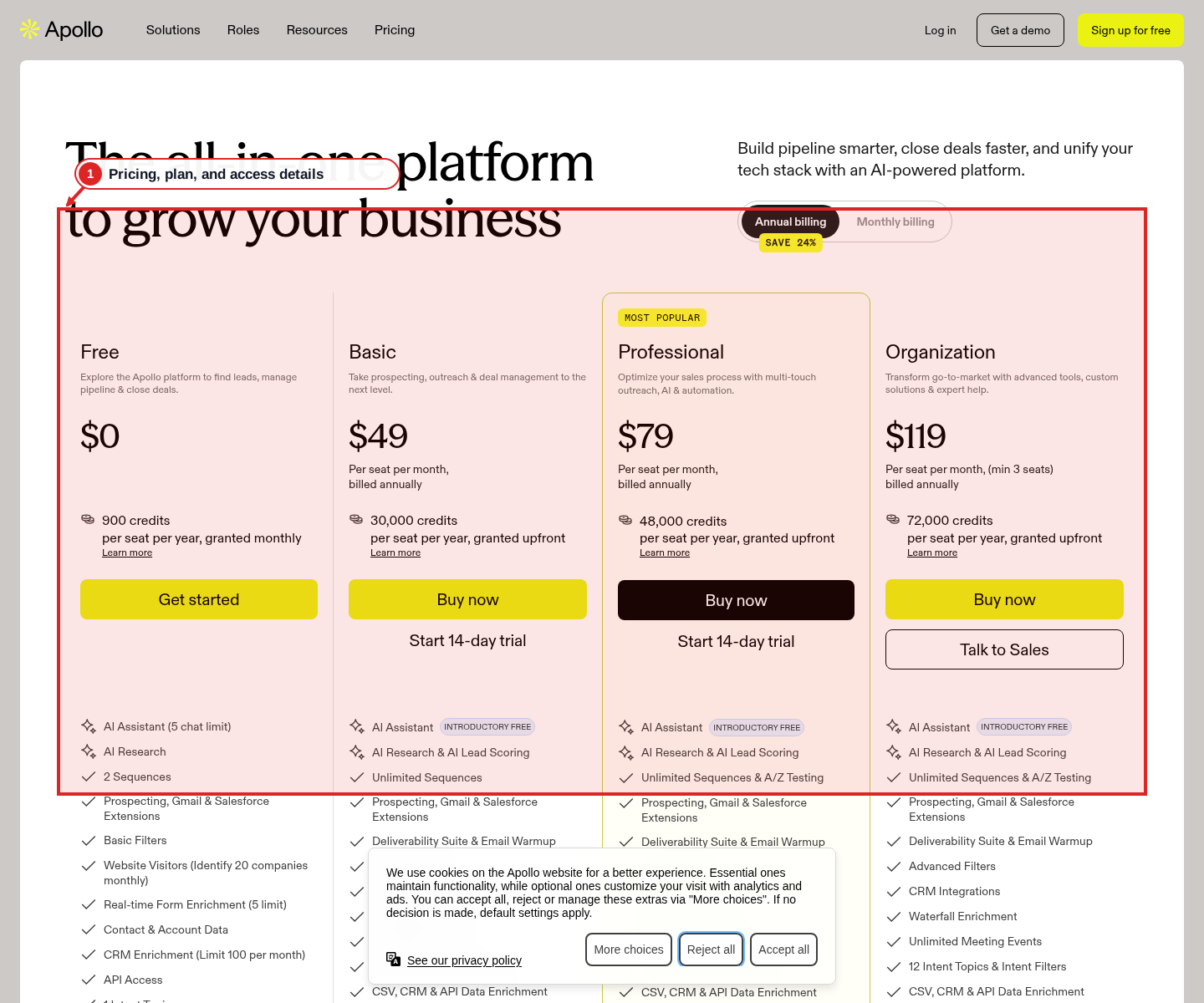
The red callout keeps the claim in its original page context. Open the linked public source below the image before relying on a mutable price, allowance, or access condition.
Source evidenceApollo pricing page showing Free, Basic, Professional, and Organization annual prices, credit allowances, and the three-seat Organization minimum.Show captureHide capture
An agency should optimize for campaign-ready output per client, not the cheapest seat. The winning platform keeps invalid rows out, makes automation predictable, and leaves enough gross margin to fund targeting and copy quality.
Frequently asked questions
What should agencies test beyond data accuracy?
Test client isolation, shared versus separate credits, export rights, audit logs, API limits, repeatable templates, and whether the contract permits the intended client delivery model.
Is Clay or Argorant the better Apollo replacement?
Clay is better for custom orchestration. Argorant is better for a narrower verified-contact production layer. Many agencies can use both without duplicating the same job.
Can an agency resell records from any of these plans?
Do not assume so. Ordinary access does not automatically grant resale, sublicensing, or white-label rights. Confirm the intended service model in the vendor's terms or contract.
Sources reviewed
Official product, documentation, and pricing pages reviewed on August 20, 2026. Vendor claims remain attributed and mutable commercial details stay in the refresh queue.
8 sources checked and datedShow sources
Test the exact market
before you commit.
Count and preview the segment, then compare the cost of usable verified output on the same sample.