Best Clay alternatives for GTM data, enrichment, and automation
Compare Clay alternatives for prospecting, enrichment, APIs, CRM workflows, and agent-led list building, with current public pricing and decisive limits.
By Argorant
Reviewed and updated August 20, 2026 by Argorant
Replace Clay only after isolating the expensive or fragile step. Argorant fits verified list building, Apollo fits an all-in-one sales workspace, Coresignal and People Data Labs fit API delivery, and HubSpot fits native CRM enrichment.
Do you need to replace Clay's tables and waterfalls, or only the data source, enrichment step, CRM sync, or agent workflow inside them?
How the shortlist was evaluated
Workflow fit
A strong database can still be the wrong product if the buyer needs orchestration, intent, or relationship signals.
Cost per finished result
Seats, credits, lookups, actions, and exports measure different things.
Usable output
Nominal records are irrelevant if the target field is missing, stale, or undeliverable.
Programmatic access
API, MCP, and CLI rights determine whether a workflow can run reliably without rep clicks.
Governance and control
Suppression, permissions, audit logs, overwrite rules, and spending limits prevent operational damage.
Provider comparison
Published database sizes, accuracy claims, and prices use different units. Every vendor statement below stays attributed; the final buying test should use the same target sample and required output fields.
| Provider | Best for | Coverage | Data type | Verification | Integrations | Agent access | Pricing shape | Decisive limitation |
|---|---|---|---|---|---|---|---|---|
| Clay | Teams that deliberately want a programmable GTM orchestration workspace. | Coverage depends on the data providers and enrichment waterfalls configured inside each table. | Workflow orchestration, provider waterfalls, signals, AI transformations, CRM enrichment, and audience activation. | Verification depends on the selected provider and workflow. Clay is the orchestration surface rather than one uniform source of verified data. | Native integrations, webhooks, CRM sync, data warehouse sync, and arbitrary HTTP integrations on Growth. | MCP controls are available on modern paid plans. Clay's product API is an Enterprise feature. | Launch starts at $185 monthly or $167 per month billed annually. Growth starts at $495 monthly or $446 annually. Actions and Data Credits are separate usage units. | The same plan can have very different economics depending on Actions, Data Credits, and private provider keys. |
| Argorant | Teams that mainly use Clay to build verified B2B contact lists. | 626.5M B2B contacts across 202 countries, with country, industry, company-size, seniority, department, and title filters. | Company and person records, verified work emails, company phones, and optional direct or mobile numbers. | Every email is checked live when you export. Invalid, unverifiable, and no-email results cost no contact credits. | CSV exports, REST API, signed webhooks, CRM and sequencer handoffs. | App, API, CLI, and MCP on every plan, the free trial included. | Starter opens at $49 monthly ($39 billed annually) for 2,000 contacts; the 5,000-contact step is $99 monthly or $79 per month billed annually. Every plan starts with a free trial. | It does not recreate arbitrary waterfalls, signal tables, or every HTTP action. |
| Apollo | Sales teams consolidating data, enrichment, and sequences in one product. | Large global company and contact database combined with sequencing, enrichment, and rep workflows. | Company records, work emails, phones, intent and engagement fields, enrichment, and outbound workflow data. | Apollo says email credits are charged only when it can verify an email, while other data and workflow actions follow their own credit rules. | CRM integrations, browser extension, CSV, workflows, and public API. | Public API and MCP access use the signed-in workspace's normal permissions and credits. | Basic is $65 monthly or $49 per seat per month billed annually. Professional is $99 monthly or $79 annually. Organization is $119 per seat per month billed annually with a three-seat minimum. | Its credit system spans several data and workflow actions, so a nominal credit is not a finished lead. |
| Coresignal | Developers building company, employee, jobs, or agentic-search workflows. | Multi-source professional, company, job, and employee data collected from more than 15 public web sources. | Company, employee, job, post, and historical headcount APIs. | Billing is tied to successful API responses, not email deliverability. Contact enrichment is a separate endpoint. | REST APIs, Elasticsearch-style search, webhooks, bulk data, and data feeds. | Agentic Search API is listed across plans. No hosted MCP server was confirmed on the public pricing documentation. | Mini is $49 monthly. Starter is $199 monthly or $2,149 annually, equal to $179.08 per month. Higher self-serve tiers run to $5,000 monthly. | It is an API data layer, not a visual GTM spreadsheet and activation workspace. |
| People Data Labs | Products and internal tools that need successful-match person or company APIs. | Global person, company, IP, job, and identity data delivered primarily through APIs and bulk products. | Person and company profiles, enrichment, search, identity resolution, and bulk datasets. | A credit is charged for a successful API profile or match. That success signal is not the same as work-email deliverability. | REST and bulk APIs, flat files, and enterprise data licenses. | API-first access is public. No hosted MCP server was confirmed. | Person Pro starts at $98 monthly or $78.40 per month on an annual commitment. Company Pro starts at $100 monthly or $80 annually. Enterprise is custom. | It does not supply Clay's orchestration, and successful profile delivery does not establish email deliverability. |
| HubSpot data enrichment | HubSpot customers that only need native CRM enrichment and controlled overwrites. | Contact and company enrichment inside eligible HubSpot subscriptions, using HubSpot's commercial dataset, third-party providers, and public information. | CRM contact and company fields, automatic enrichment, continuous refresh, and configurable overwrite rules. | HubSpot says it verifies business information across multiple sources. Contacts require a business email and companies require a domain. | Native HubSpot CRM objects, workflows, imports, forms, and HubSpot APIs. | HubSpot agents and smart properties can use HubSpot Credits. No standalone enrichment MCP claim was confirmed. | An eligible paid HubSpot subscription is required. Smart CRM displays Professional at $45 per month and Enterprise at $75 per month, but total cost depends on the purchased Hub and seats. | It is strongest inside HubSpot and is not a vendor-neutral waterfall builder. |
| ZoomInfo | Enterprises that want broad data, intent, enrichment, and workflow capabilities under one contract. | Broad sales intelligence, company and contact data, intent, enrichment, workflows, and enterprise GTM applications. | Company and person records, phones, emails, intent, technographics, enrichment, and workflow signals. | Verification and data-quality terms depend on the purchased product and contract. Buyers should test the exact export they plan to use. | CRM, marketing automation, data enrichment, APIs, and GTM workflow products. | API, MCP, and agentic access depend on the purchased ZoomInfo or GTM AI offer and should be written into the quote. | ZoomInfo Lite is free with 10 monthly credits. Community Edition raises that allowance to 25. Paid platform pricing is not public and is generally quote-led and annual. | Pricing and automation entitlements are quote-led, which makes small workflow economics hard to inspect. |
Worked pricing scenario: Published entry commitments
Assumptions
- Clay Launch uses its current starting configuration.
- Argorant Starter produces deliverable contacts rather than an orchestration workspace.
- Annual equivalents require annual billing.
The $1,056 annualized difference matters only if the buyer does not need Clay's orchestration. If Clay removes several other tools or manual steps, its higher entry price can still be the lower workflow cost.
What the published product page shows
The red callout keeps the claim in its original page context. Open the linked public source below the image before relying on a mutable price, allowance, or access condition.
Source evidenceClay public pricing page showing Free, Launch, Growth, and Enterprise plans with separate Action and Data Credit allowances.Show captureHide capture
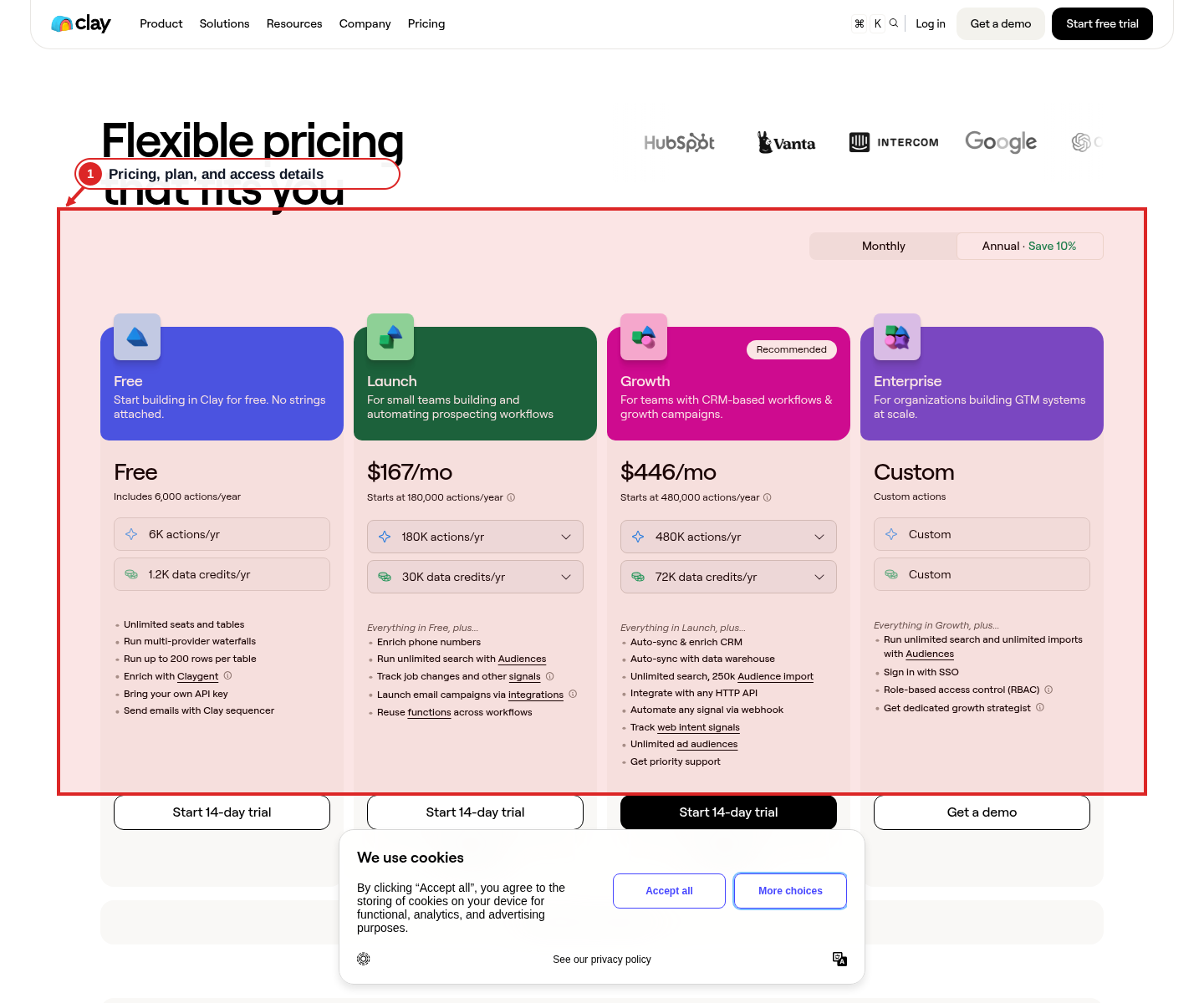
For a narrow verified-list workflow, a dedicated data layer removes cost and failure points. For multi-provider enrichment and activation, Clay remains the benchmark and should be replaced only by a deliberately designed stack.
Frequently asked questions
What is the closest full Clay replacement?
There is no exact replacement in this list. Apollo and ZoomInfo cover more workflow in one product, while APIs plus n8n can recreate selected automations. Neither automatically recreates Clay's tables, waterfalls, and provider marketplace.
Why can Clay credits not be compared directly with contact credits?
Clay now separates Actions from Data Credits, and a finished record can consume several provider and AI steps. Compare the complete table workflow, not one unit.
When is Argorant a sensible Clay alternative?
When the desired outcome is a filtered, deliverable B2B contact list through UI, API, CLI, or MCP, rather than a general GTM orchestration workspace.
Sources reviewed
Official product, documentation, and pricing pages reviewed on August 20, 2026. Vendor claims remain attributed and mutable commercial details stay in the refresh queue.
7 sources checked and datedShow sources
Related research
Test the exact market
before you commit.
Count and preview the segment, then compare the cost of usable verified output on the same sample.