Apollo vs Hunter vs Argorant for Email Finding
A workflow comparison of broad database prospecting, domain-based email finding, and verified contact search, normalized to the cost of 100 usable work emails.
By Argorant
Reviewed and updated August 20, 2026 by Argorant
Choose Apollo when you want a broad prospecting platform, Hunter when your task starts with domains or known names, and Argorant when you want to define an ICP, inspect the market, and buy verified contacts without a mandatory subscription. The fairest test starts with the same company or person inputs and ends with unique work emails checked by one independent email checker.
What works today
Each label shows how a path works today: a direct Argorant connection, a documented setup, a generic HTTP call, a CSV file, or something to check in your own account first.
Apollo
MCPHosted OAuth MCP plus API and application search; action-level credits and plan rights vary.
Hunter
MCPRemote MCP and API for domain search, email finding, and verification under ordinary plan credits.
Argorant
MCPMCP, REST, and CLI for ICP search, count, masked preview, verified reveal, and export.
Step by step
- 1
Choose a fair starting input
Use either the same 100 domains and names or the same ICP, then document where a provider requires a different input.
Expected result: The comparison does not reward a tool for solving a different task. - 2
Collect unique outputs
Run each workflow, remove duplicates, and preserve provider status and timestamp.
Expected result: A clean denominator of attempted and returned rows. - 3
Check emails independently
Check all work emails with the same independent email checker.
Expected result: Valid, invalid, catch-all, and unknown distributions for each source. - 4
Calculate effective cost
Divide total required cash and credits by unique usable work emails.
Expected result: A buyer-relevant cost comparison.
Inspect the market before a paid action
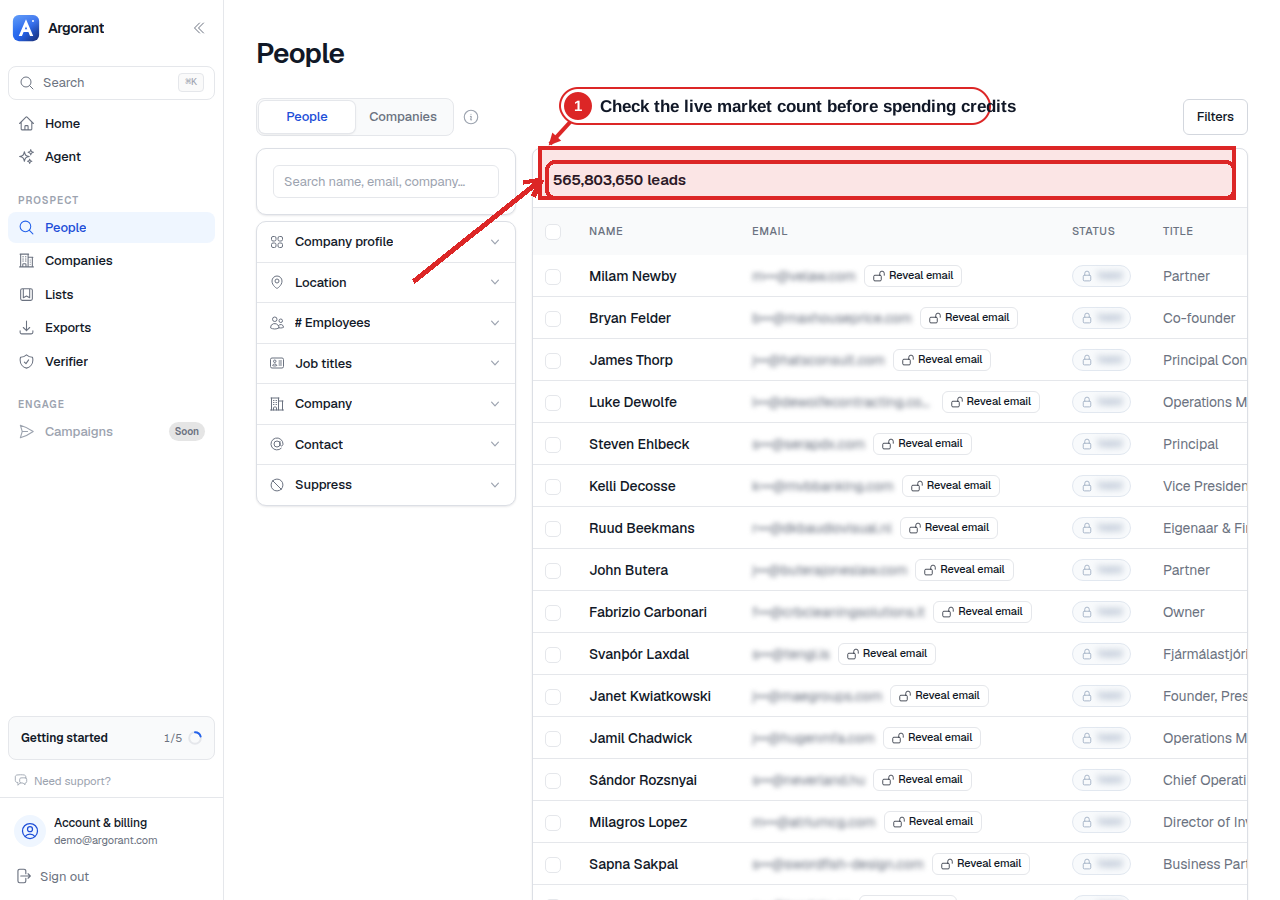
The result count comes first. It lets you or your agent check that the filters describe the right market before any contact is revealed or exported.
Plans, credits, and access gates
| Provider or layer | What to know | Published price |
|---|---|---|
| Argorant | One-time credit packs from $0.035 per contact, no subscription. Search and previews are free. | See the vendor's current pricing. |
| Hunter | Free includes 50 monthly credits; Starter is $49 monthly or $34/month annual equivalent. Different operations can consume credits differently. | See the vendor's current pricing. |
| Apollo | Public tiers and normal credits apply; confirm search, export, enrichment, API, and mobile limits separately. | See the vendor's current pricing. |
Best fit by job
| Option | Best for | Access | Cost model | Verdict |
|---|---|---|---|---|
| Apollo | Broad database search and sales workflows | UI, API, official MCP | Plan plus action credits | Best all-in-one breadth of the three, but credit normalization is essential. |
| Hunter | Known-domain and known-person email finding | UI, API, remote MCP | Monthly plan credits | Focused, transparent option when the company universe already exists. |
| Argorant | ICP-to-verified-list and irregular usage | UI, REST, MCP, CLI | Plan or one-time credit packs | Best when finding the market and getting verified contacts should happen in one controlled workflow. |
Frequently asked questions
Is Hunter directly comparable to an ICP database?
Only for a task where the company or person inputs are already known. Hunter's strength is focused email discovery; an ICP database begins earlier in the workflow.
Should catch-all results count as usable?
Report them separately. If you only send to valid emails, do not count catch-all or unknown results as valid.
Sources reviewed
Official product, developer, pricing, and policy pages reviewed on August 20, 2026. Prices and plans change, so check the vendor's current page before you buy.
Continue the workflow
Prove the workflow
before you scale it.
Count and preview first, then approve verified contacts with a clear spending limit.