Comparison

Lusha vs Argorant

Lusha is a mature B2B contact-data platform with a strong browser-extension workflow, published credit mechanics, API access, and an MCP path for AI clients. Argorant is the focused alternative for teams that want verified B2B contact coverage, company intelligence, email-format pages, org-chart coverage, exports, API access, and OAuth-protected MCP controls.

Bottom line

Choose Lusha when browser-first prospecting, LinkedIn/Sales Navigator lookup, CRM-side enrichment, and an established credit-based workflow matter most. Choose Argorant when the job is a broader verified-contact data layer with aggregate account pages, clean reveal and export governance, and agent-ready access that makes real people, full email addresses, phones, profile URLs, and exports available after sign-in.

Browser prospecting
Lusha

Lusha is stronger today when reps want a Chrome or Edge extension on LinkedIn, Sales Navigator, CRM records, Gmail, or company websites.

Argorant

Argorant is stronger when account research, free tools, public company pages, exports, API access, and MCP matter more than browser lookup alone.

Credit diligence
Lusha

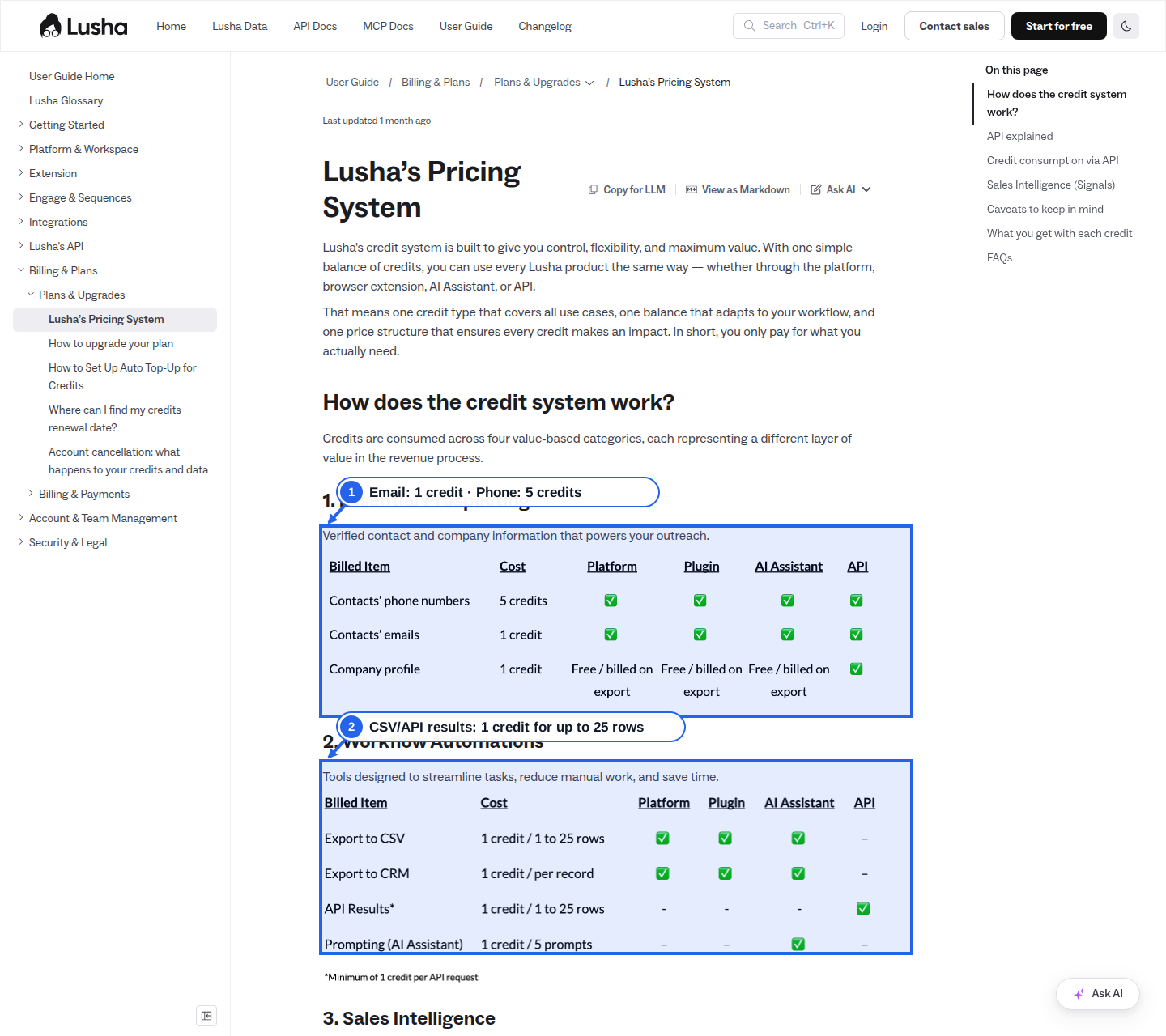
Lusha publishes credit mechanics, but buyers need to map the exact channel because public pricing, API docs, and MCP usage can express phone and request costs differently.

Argorant

Evaluate Argorant by cost per usable exported contact, account permissions, reveal plan limits, export caps, API/MCP limits, and whether the workflow is predictable for humans and agents.

API and MCP
Lusha

Lusha has a documented MCP path for Claude, ChatGPT, Cursor, VS Code, and local npx usage, plus API-key and OAuth setup paths.

Argorant

Argorant's public MCP access is stricter: masked search and fetch previews first, OAuth-protected access, plan limits, and sensitive reveal and export kept out of public MCP tools.

public research pages
Lusha

Lusha is not primarily known for the same public company-page footprint as RocketReach or Prospeo, though it has strong product pages for extension and API workflows.

Argorant

Argorant is strongest in this motion with company pages, email-format pages, org-chart pages, comparison guides, alternatives guides, and free tools that are useful without exposing real contact data.

Scorecard
AreaLushaArgorantBuyer note
Product centerBrowser-first B2B contact lookup, prospecting, enrichment, extension workflows, API access, AI assistant behavior, and MCPVerified B2B contact data, company intelligence, email-format pages, org-chart pages, exports, API access, and OAuth-protected MCPLusha is stronger as an established rep workflow. Argorant is stronger as a focused data layer and aggregate acquisition system.
CreditsPublished credit model, including reveal contacts, API result, signal, and channel-specific usage details that buyers must model carefullyAccount-controlled reveal and export/API/MCP economics best evaluated by usable verified output rather than only plan namesDo not compare only monthly credits. Model emails, phones, API requests, exports, duplicate behavior, and agent usage.
ExtensionStrong current extension story for LinkedIn, Sales Navigator, CRM, Gmail, and company websitesExtension is a planned growth wedge, not the current core public workflowThis is one place where Lusha clearly has mature distribution today.
API and MCPOfficial API help, API-key management, MCP setup for several clients, remote MCP, local npx setup, and tool categoriesPublic OAuth-protected MCP with masked preview behavior, plus API direction around plan limits, export caps, and admin controlsBoth are agent-aware. The diligence is how much data an agent can reveal contacts, export lists, and spend without human control.
Public safetyPublic product pages and docs; buyers should inspect any public result pages for data exposure and conversion behaviorAggregate coverage, sample contact examples, masked previews, and no public full email addresses, phones, profile URLs, or exportsArgorant's public-page advantage should be depth without publishing sensitive contact details.
Lusha pricing

Credit-based packaging with Free, paid self-serve, and Scale/custom motions. Official pages describe free monthly credits, credit rollover rules, data-point costs, API result costs, and plan-specific controls.

Model usage carefully. Lusha's public pricing page describes phone reveal as 10 credits, while API/help docs describe phone data as 5 credits in API contexts and add request/result costs. Buyers should verify the current plan and channel-specific usage before committing.

Argorant pricing

Focused verified-contact data layer with privacy-first pages, free tools, signed-in reveal contacts, export lists controls, API access, and OAuth-protected MCP behavior.

Evaluate Argorant by verified contact depth, email-format coverage, org-chart coverage, export fields, API/MCP behavior, plan limits, and how safely humans or agents can move from preview to reveal.

Plan and pricing snapshot

Plan pages and quote terms can change by billing cycle, seats, credits, and add-ons. Use this section to compare public details and the questions worth confirming before you commit.

Lusha pricing guide screenshot captured from SpendHound on June 2, 2026.
Lusha
Checked June 2, 2026
Plan details reviewed
Official page shows Free at $0, Starter at $37.45/month, Pro at $52.45/month, and Premium at $299.95/month when billed yearly.
Official Scale tier is custom.
Third-party SpendHound reference shows average SMB and enterprise annual pricing from tracked customer spend.
What buyers should check

Lusha publishes self-serve pricing for smaller plans while larger Scale and enterprise buying still depends on credits, seats, API access, and negotiated terms.

Compare credit-per-contact math carefully. Argorant gives buyers clearer visibility into higher limits, export caps, and MCP usage before a sales call.

Lusha pricingLusha pricing systemSpendHound Lusha pricing
Plan page reviewed
Argorant
Argorant
Checked June 2, 2026
Plan details reviewed
Free plan for testing coverage.
Starter starts at $99/month.
Pro starts at $249/month.
Scale starts at $579/month on monthly billing or $434/month when billed annually.
What buyers should check

Higher-volume plans can be scoped around seats, exports, API access, MCP usage, and admin controls instead of forcing a full sales-intelligence suite.

Best when the buyer wants transparent limits, high-volume contact search, export controls, and AI-agent access without a quote-only starting point.

Argorant pricing
Cost controls to model

A pricing page is only the first screen. Real cost shows up when seats, credits, exports, automation, and renewal language interact.

1
Seats

Minimum users, admin seats, and paid workspace members.

2
Credits

Email, phone, enrichment, API, and AI-agent usage rules.

3
Exports

CSV, CRM push, list download, and re-export limits.

4
Automation

API, MCP, browser extension, and workflow permissions.

5
Renewal

Annual term, cancellation, uplift, and overage language.

The real buying decision

Lusha versus Argorant is mostly a workflow question. Lusha is already strong when a rep wants to browse LinkedIn, Sales Navigator, a CRM record, Gmail, or a company website and reveal contact data in context. That matters because extension distribution can become the daily habit for SDRs.

Argorant's stronger angle is different. It is the verified-contact data layer with privacy-first company pages, email-format pages, org-chart pages, comparison content, alternatives content, free tools, clean exports, API access, and MCP access that respects account controls.

Pricing and credits

Lusha's official sources are useful but require careful reading. The pricing page explains free monthly credits and public examples for email and phone reveal. The help center explains API credit categories, data-point costs, result costs, minimum request costs, bulk-result charging, and credit rollover behavior.

That means buyers should not treat one credit number as the whole story. A team revealing mostly emails will spend differently from a team revealing phones, using API enrichment, retrieving company profiles, triggering signals, or letting AI clients make repeated requests.

Where Lusha is stronger

Lusha is stronger today for extension-led prospecting. Its official extension page describes workflows on LinkedIn, Sales Navigator, CRMs, supported company sites, and across the web. Its help center also describes Chrome and Edge support, CRM export, sequence handoff, job-change indicators, and plan-dependent bulk behavior.

Lusha is also credible for AI workflows. Its MCP guide describes setup for Claude, ChatGPT, Cursor, VS Code, and other MCP-compatible clients. It also documents remote MCP, local npx setup, API-key requirements, and security advice.

Where Argorant is stronger

Argorant is stronger when the buyer wants a safer public-to-private data path. Public pages can show company facts, email patterns, role coverage, management coverage, org-chart signals, competitors, and comparison context without exposing real contact identities, full email addresses, phone numbers, profile URLs, or exportable records.

That safety line matters more once AI agents enter the workflow. Search and fetch should preview coverage and account context. Revealing real people, exporting lists, and spending large plan limits should require a signed-in account, limits, auditability, and admin controls.

How to test both fairly

Use one controlled sample: 25 target companies, three buyer titles, two countries, and one export destination. In Lusha, test extension lookup, company search, email availability, phone availability, duplicate behavior, CRM handoff, API rights, MCP behavior, and credit consumption. In Argorant, test company pages, email-format pages, org-chart coverage, verified email output, export fields, API/MCP previews, and signed-in reveal controls.

Then count usable output. Relevant contacts found, verified emails, phone fields, stale titles, duplicate records, export completeness, API behavior, extension speed, and total credit or plan cost matter more than a vendor's generic database claim.

The extension wedge

Lusha's extension is a real distribution advantage. A rep who can reveal and save contacts without leaving the page has less friction than a rep who has to copy a domain into a separate search screen.

Argorant treats that as a product lesson. A future Chrome extension can be a useful entry point, but it should feed the larger Argorant account graph: company pages, email formats, org-chart coverage, verified reveal contacts, export lists, API usage, MCP usage, and account-level controls.

Evaluation checklist
Ask for seats, credits, exports, phone access, API access, and renewal terms in writing.
Run both products on the same target-account sample before judging coverage.
Check catch-all handling, invalid email handling, and whether re-checks cost extra.
Compare cost per usable exported contact, not only headline database size.
Confirm CRM, CSV, API, and AI-agent workflows before committing.
Decide whether you need a focused data workflow or a broader enterprise GTM suite.
Frequently asked questions
Is Lusha better than Argorant?

Lusha is better when the team wants an established browser-extension workflow and credit-based prospecting product. Argorant is better when the job is a focused verified-contact data layer with privacy-first company pages, org-chart coverage, exports, API access, and OAuth-protected MCP controls.

Does Lusha have MCP?

Yes. Lusha publishes MCP setup guidance for Claude, ChatGPT, Cursor, VS Code, and other MCP-compatible clients, including remote MCP and local npx setup paths. Buyers should verify API-key, credit, and permission behavior for their plan.

How do Lusha credits work?

Lusha uses credits for contact data and API workflows. Official sources describe email reveal, phone reveal, company data, API results, bulk requests, signals, rollover, and minimum request charges. Because channel-specific rules can differ, buyers should model their exact workflow before comparing costs.

Which is better for AI SDR workflows?

Lusha is strong if the team wants an established MCP and API path tied to Lusha's credit system. Argorant is stronger when the team wants masked previews, privacy-first pages, OAuth-protected MCP, reveal plan limits, export caps, and admin controls around a broader verified-contact data layer.

Pages reviewed
Lusha pricing page

Official pricing page and FAQ covering free-plan credits, public credit examples, cancellation, rollover, and Scale customization.

Lusha pricing system

Official help article explaining credit categories, API credit consumption, data-point costs, API result costs, bulk-request rules, and rollover behavior.

Lusha API help

Official API help article covering API keys, Premium and Scale availability, MCP entry points, credit costs, request minimums, bulk limits, and API key credit caps.

Lusha MCP server guide

Official MCP guide for Claude, ChatGPT, Cursor, VS Code, and other clients, including OAuth remote MCP, npx setup, tool categories, API-key requirements, and security notes.

Lusha Chrome extension

Official extension page describing LinkedIn, Sales Navigator, CRM, company-site, save-to-list, CRM handoff, and bulk export workflows.

Lusha extension help

Official help article explaining where the Chrome and Edge extension works, what it can reveal, and how extension features vary by plan.

Try Argorant before you enter a sales cycle.

Search verified contacts, check coverage, and export a clean list before deciding which platform belongs in your stack.

Start free
Loved by revenue teams
We run cold outbound for a dozen clients. Argorant replaced two tools and the bounce complaints just stopped.
Founder of a bootstrapped outbound agency · Lisbon, Portugal