Prospeo vs Argorant
Prospeo is a serious email-finder and prospecting platform with published credit rules, Chrome workflows, public company pages, API access, and a hosted MCP server. Argorant is the focused alternative for teams that want a larger verified-contact data layer, company intelligence, org-chart coverage, exports, and OAuth-protected MCP workflows with strict reveal controls.
Choose Prospeo when you want a self-serve email finder with transparent credits, Chrome prospecting, API access, and an MCP server that already exposes enrichment and search workflows. Choose Argorant when the job is broader verified B2B contact coverage, privacy-first company pages, account research, company/org-chart depth, and a data layer where full contact details and exports are available only after sign-in.
Evaluate Argorant by verified contacts, company depth, export quality, API/MCP fit, and whether the workflow needs the 614M-contact data layer.
Prospeo is strong when the team wants email and mobile finding with published credit rules and no charge when no valid result is returned.
Argorant's public pages show aggregate counts, sample email examples, masked contact previews, company coverage, org-chart signals, and clear sign-in prompts.
Prospeo already has public company and email-format pages with company facts, employees, departments, funding, technology, and conversion paths.
Argorant is the better fit when the buyer wants OAuth-protected MCP with masked search and fetch previews, plan limits, export caps, and admin controls before contact reveal.
Prospeo has official API docs and MCP docs, including hosted and local MCP, enrich/search tools, OAuth/API-key authentication, and credit usage rules.
Argorant is the better fit when browser lookup is only one part of a larger company-intelligence and verified-contact workflow.
Prospeo is stronger today for browser-first email and mobile lookup because it already has a Chrome Web Store extension with a visible user base.
| Area | Argorant | Prospeo | Buyer note |
|---|---|---|---|
| Product center | Verified B2B contact data, company intelligence, email-format pages, org-chart pages, exports, API/MCP access, and account-controlled reveal | Email finder, mobile finder, company search, enrichment, public company pages, Chrome extension, API access, and MCP | Prospeo is not a weak competitor. The real difference is whether the buyer wants an email-finder-led product or a broader verified-contact data layer. |
| Pricing model | Public entry plans with account-controlled reveal contacts, export lists, API access, and MCP access | Free, Starter, Growth, and Pro plans with shared team credits; credits are used for verified email, mobile, company enrichment, and search pages | Prospeo's credit documentation is unusually concrete. Argorant gives buyers a clearer way to model usable exported contacts and account controls. |
| Public page strategy | Aggregate coverage, sample email examples, masked contact previews, no public full email addresses, no public phones, no public exports | Public company and email-format pages that show patterns, company data, employee distributions, funding, technology, and key-contact style conversion blocks | Both can help buyers research accounts. Argorant keeps the public preview useful while reserving contact details for signed-in users. |
| Automation | Hosted MCP and API access with OAuth, masked previews, plan limits, export caps, and admin controls | Hosted MCP at mcp.prospeo.io plus local npx server; API docs cover enrichment, search, bulk enrich, company data, and rate limits | Prospeo is already agent-aware. Argorant's advantage is data depth, safety, and predictable reveal and export governance. |
| Best buyer fit | Founders, agencies, RevOps, GTM engineers, AI SDR builders, and teams that want a contact-data layer to feed existing systems | Teams that want a self-serve email finder with Chrome lookup, credits, enrichment, API access, and an existing MCP path | The buyer should test both on the same accounts instead of comparing landing-page claims. |
Public Free, Starter, Pro, and Scale plan structure, with reveal, export, API, and MCP behavior controlled by account permissions and plan limits.
Evaluate Argorant by verified contact depth, aggregate account coverage, export fields, API/MCP fit, org-chart pages, and whether it can become the core data layer for your stack.
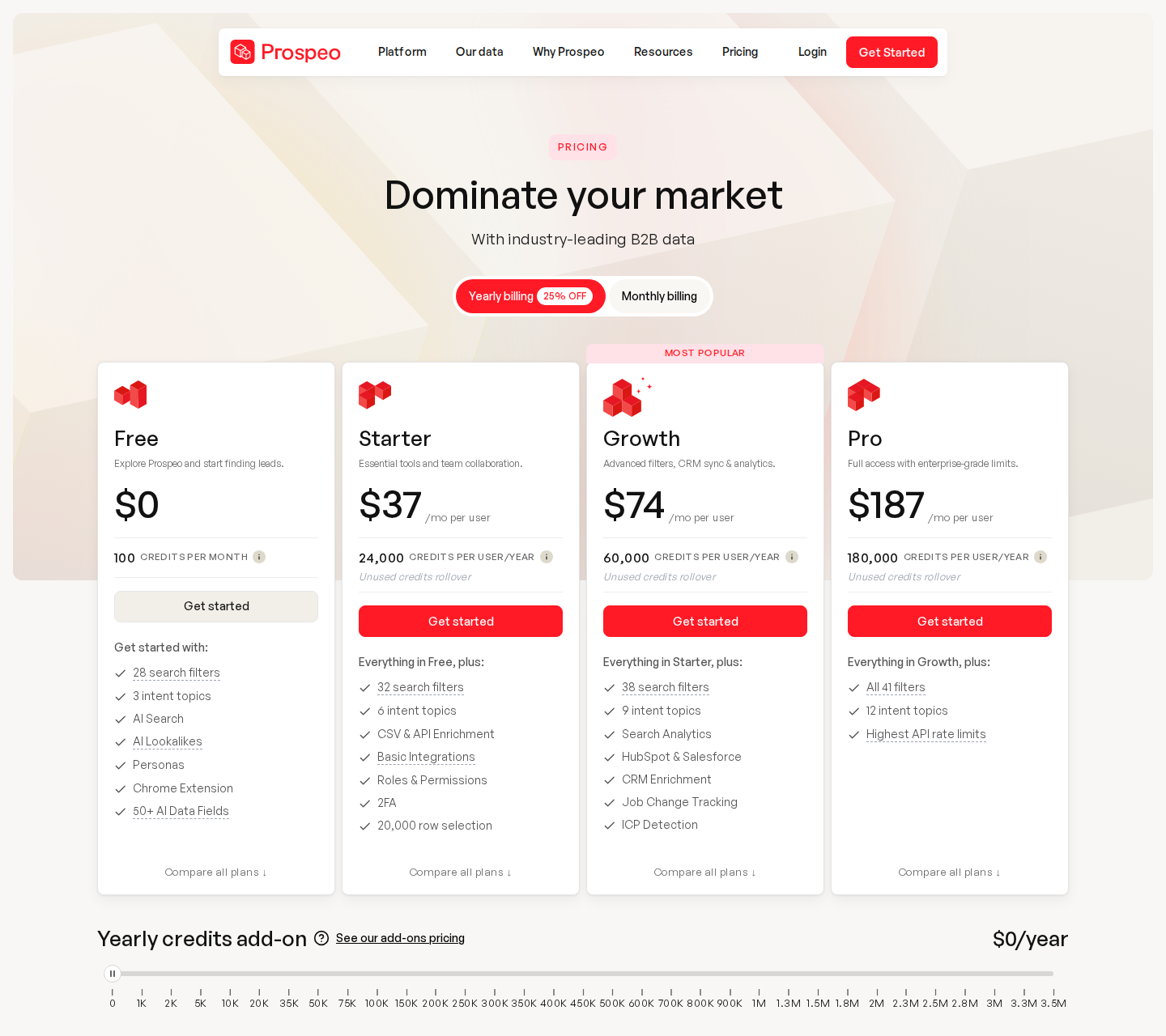
Official help docs describe Free, Starter, Growth, and Pro plans with 100, 2,000, 5,000, and 15,000 credits per user/month respectively, shared team credits, monthly or yearly billing, and add-ons on paid plans.
Prospeo says verified email reveal costs 1 credit, mobile reveal costs 10 credits and includes email, company enrichment costs 1 credit, search API costs 1 credit per results page, and no-result requests do not consume credits.
Plan pages and quote terms can change by billing cycle, seats, credits, and add-ons. Use this section to compare public details and the questions worth confirming before you commit.

Check how credits are counted across email reveal, mobile reveal, company enrichment, API access, and MCP workflows before comparing monthly price alone.
Prospeo is strongest for email finding and company-data workflows. Argorant is better suited when the team needs larger verified contact coverage, export controls, and AI-agent access in one place.
Higher-volume plans can be scoped around seats, exports, API access, MCP usage, and admin controls instead of forcing a full sales-intelligence suite.
Best when the buyer wants transparent limits, high-volume contact search, export controls, and AI-agent access without a quote-only starting point.
A pricing page is only the first screen. Real cost shows up when seats, credits, exports, automation, and renewal language interact.
Minimum users, admin seats, and paid workspace members.
Email, phone, enrichment, API, and AI-agent usage rules.
CSV, CRM push, list download, and re-export limits.
API, MCP, browser extension, and workflow permissions.
Annual term, cancellation, uplift, and overage language.
Prospeo versus Argorant is not a simple email-finder comparison. Prospeo has moved beyond a lightweight finder: it has company search, email and mobile enrichment, public company pages, Chrome extension workflows, API docs, and MCP docs. That makes it a credible option for teams that want a self-serve, credit-based prospecting layer.
The stronger Argorant position is different: a verified-contact data layer with safer public pages, company intelligence, org-chart pages, comparison pages, free tools, clean exports, API access, and OAuth-protected MCP.
Prospeo's help center is clear about credit mechanics. Credits are shared across the team, unused credits do not roll over, verified email reveal costs 1 credit, mobile reveal costs 10 credits, company enrichment costs 1 credit, and search pages can cost 1 credit when they return results. It also says no-result enrichment is not charged.
That means the buyer should model the exact workflow. A team mostly finding verified work emails will burn credits differently from a team revealing many mobile numbers, enriching companies, or paging through search results by API. Compare that with Argorant by cost per usable exported contact and by how well reveal and export limits fit the team's controls.
Prospeo is stronger today when the buyer wants an already-packaged Chrome extension, self-serve credits, email/mobile finding, API access, and a documented MCP server. Its Chrome Web Store listing and official help pages make it easy to understand the product without a sales call.
Prospeo also has a strong public search-page motion. Its company and email-format pages include patterns, overview data, employee distributions, funding, technology stack, trending companies, and CTAs. Argorant uses the same page-family lesson without copying Prospeo's design or exposing sensitive contact data publicly.
Argorant is stronger when the buyer wants broader B2B contact coverage and a safer account-research layer. Public pages can show company facts, email patterns, role coverage, org-chart signals, technology readiness, competitors, and comparison guides without publishing real people, full email addresses, phone numbers, or exports.
Argorant's MCP access is designed around stricter data controls. Search and fetch can return masked coverage previews, while contact details and export lists stay behind account controls. That matters for AI SDR workflows because agents can consume data much faster than humans can click through a UI.
Run one controlled sample: 25 target companies, three buyer titles, two countries, and one export destination. In Prospeo, test Chrome lookup, email hit rate, mobile availability, company enrichment, API rate limits, MCP behavior, and credit burn. In Argorant, test company pages, email-format pages, org-chart coverage, verified email output, export fields, API/MCP previews, and signed-in reveal controls.
Then count usable output. Relevant contacts found, verified emails, mobile fields, stale titles, duplicate records, export completeness, API behavior, and total credit or plan cost matter more than claims about database size.
Prospeo's public company pages show why this page family matters: company pages, email-format pages, funding sections, tech stack sections, employees, and related companies can all help buyers research accounts.
Argorant draws the line differently. A public teaser can be compelling with masked cards, aggregate coverage, sample email examples, role signals, and sign-in CTAs. The public page does not expose real contact identities, full email addresses, direct phones, profile URLs, or exportable records.
Prospeo is better when the team wants a self-serve email finder with Chrome workflows, published credit rules, API access, and existing MCP support. Argorant is better when the job is broader verified-contact coverage, company intelligence, org-chart pages, clean exports, and OAuth-protected reveal and export controls.
Yes. Prospeo publishes MCP documentation for hosted and local server options, with tools for enrichment, search, company profiles, and account information. Buyers should verify credit usage and authentication requirements for their workflow.
Prospeo's help center says verified email reveal costs 1 credit, mobile reveal costs 10 credits and includes email, company enrichment costs 1 credit, search API costs 1 credit per results page, and no-result enrichment is not charged.
Prospeo already has strong public company and email-format pages. Argorant is built for deeper company intelligence, email-format pages, org-chart pages, comparison pages, technology pages when data is ready, and free tools that do not expose real contact data publicly.
Pricing page covering Free, Starter, Growth, and Pro plans, included credits, filters, integrations, API access, team billing, credit expiry, and add-ons.
Official credit rules for verified email reveal, mobile reveal, company enrichment, search pages, no-result behavior, re-enrichment, rollover, and shared team credits.
Official API documentation describing person enrichment, company enrichment, bulk endpoints, people search, company search, account usage, authentication, and rate limits.
Official help article showing different Search and Enrich endpoint limits by plan, plus how successful requests and rate-limited requests are counted.
MCP documentation covering hosted and local setup, enrich and search tools, credit usage, masked previews, and support for MCP-compatible clients.
Official authentication documentation for local API-key mode, hosted OAuth mode, manual OAuth credentials, and direct API-key header access.
Chrome Web Store listing for Prospeo's extension, including rating, user count, publisher, and extension positioning around finding emails and mobile numbers.
Public Prospeo company/email-format page example showing email patterns, company overview, employees, departments, funding, and a conversion path to verified emails.
Public Prospeo company page example showing company facts, email formats, employee distribution, funding, tech stack, trending companies, and FAQ content.
Search verified contacts, check coverage, and export a clean list before deciding which platform belongs in your stack.
Start free