RocketReach vs Argorant
RocketReach is a visible incumbent for email finding, phone lookup, public company pages, and browser-extension prospecting. Argorant is the focused alternative for teams that want verified contacts, company intelligence, cleaner export economics, and OAuth-protected API/MCP workflows.
Choose RocketReach when your team wants a familiar email-finder workflow with a large public profile surface and browser extension. Choose Argorant when the job is verified contact data, masked account previews, clear reveal and export controls, and a data layer that can serve humans, automations, and AI agents without exposing real people publicly.
Argorant is strongest when the team wants domain pages, email-format pages, and signed-in reveal and export controls rather than extension-first lookup alone.
RocketReach has a well-known Chrome extension workflow for prospecting on social sites and company pages.
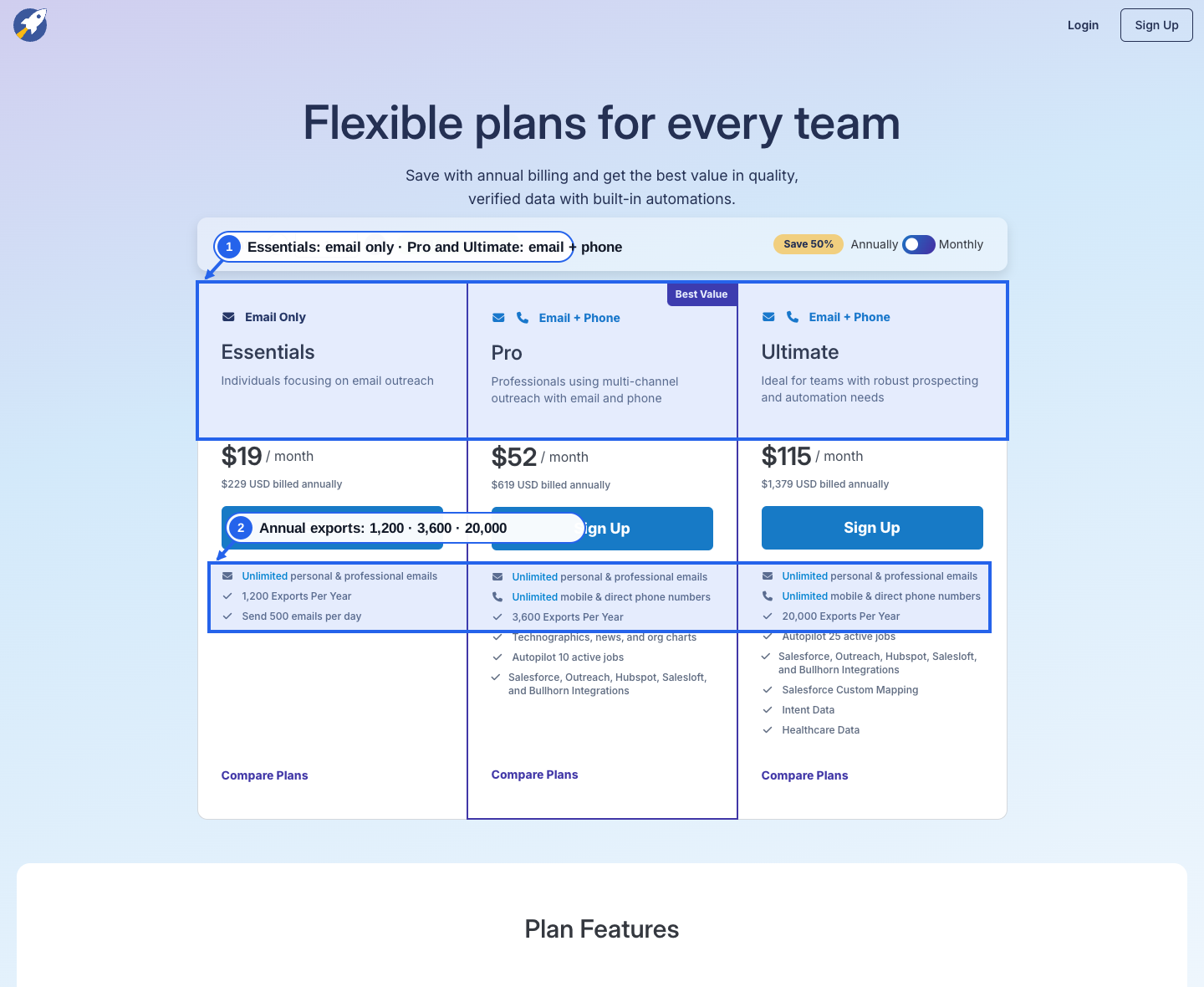
Argorant publishes entry plans and is best evaluated by cost per usable verified contact, export quality, API access, and MCP fit.
RocketReach pricing is best checked at purchase time because public reports vary by individual versus team plan, billing mode, region, lookups, exports, phone access, and API access.
Argorant's public pages show aggregate company, email-format, org-chart, and role coverage while making real people, full email addresses, phones, and exports available after sign-in.
RocketReach has strong public pages for email formats, company profiles, management, technology, and competitors, which helps buyers find company email and contact-path information.
Argorant is designed around OAuth-protected MCP, plan limits, masked previews, and admin controls so agents can inspect coverage before reveal and export.
RocketReach buyers should verify API access, export limits, credit behavior, and whether automated agent usage is allowed under their plan or contract.
| Area | Argorant | RocketReach | Buyer note |
|---|---|---|---|
| Product center | Verified B2B contact data, public company intelligence, exports, API/MCP access, and account-controlled reveal | Email finder, phone lookup, public profile/company pages, browser extension, and search workflow | RocketReach is very visible in public discovery. Argorant competes by making the public layer safer and the logged-in workflow cleaner. |
| Public data posture | Aggregate coverage, sample contact examples, masked previews, and no real people or contact details exposure on public pages | Large public profile and company-page footprint | Public pages are good for acquisition, but the safety line matters: real people and contact details should sit behind account controls. |
| Pricing model | Public entry plans plus workflow-specific limits for reveals, exports, API, and MCP | Plan and lookup/export mechanics vary across public reports; direct checkout or quote verification is required | Compare total cost per usable exported contact, not only per-seat sticker price. |
| Verification and exports | Verification-first positioning with export controls and deliverability-sensitive workflows | Lookup and export mechanics require careful testing, especially for phone access, bulk lookup, CRM sync, and API use | The right benchmark is the same account sample in both tools: relevant contacts found, verified, exported, and usable. |
| Automation readiness | OAuth-protected MCP and API access with plan limits, masked previews, and admin controls | API and Salesforce-style workflows appear to be higher-tier or team/custom considerations in public pricing guides | Agentic workflows consume data faster than human click paths, so API rights and plan limits need explicit review. |
Public Free, Starter, Pro, and Scale plan structure, with reveal and export/API/MCP behavior controlled by account permissions.
Evaluate Argorant by verified contacts, aggregate coverage depth, export quality, API/MCP fit, and whether the workflow avoids buying unrelated suite features.
Public pricing is best treated as checkout-dependent. 2026 third-party guides report individual and team tiers with different annual/monthly assumptions, lookup limits, export mechanics, phone access, and API gating.
Confirm the current RocketReach checkout page or quote directly. Ask what counts as a lookup, what counts as an export, whether failed lookups are refunded, whether phone/API/Salesforce access is included, and how team seats are billed.
Plan pages and quote terms can change by billing cycle, seats, credits, and add-ons. Use this section to compare public details and the questions worth confirming before you commit.

Third-party references describe higher team pricing, user-based economics, and add-on lookup costs once teams need phones, integrations, and larger export volumes.
Strong public discovery surface and browser workflows. Buyers should compare annual export limits, lookup add-ons, mobile access, and team billing against Argorant's higher-volume needs.
Higher-volume plans can be scoped around seats, exports, API access, MCP usage, and admin controls instead of forcing a full sales-intelligence suite.
Best when the buyer wants transparent limits, high-volume contact search, export controls, and AI-agent access without a quote-only starting point.
A pricing page is only the first screen. Real cost shows up when seats, credits, exports, automation, and renewal language interact.
Minimum users, admin seats, and paid workspace members.
Email, phone, enrichment, API, and AI-agent usage rules.
CSV, CRM push, list download, and re-export limits.
API, MCP, browser extension, and workflow permissions.
Annual term, cancellation, uplift, and overage language.
RocketReach versus Argorant is not only an email-finder comparison. RocketReach has a strong public footprint: email-format pages, company profiles, management-style pages, technology pages, and a Chrome extension workflow. That public surface makes it visible to buyers researching company email formats and employee contact paths.
Argorant's opportunity is to build the same acquisition surface with stricter safety and better workflow focus. Public pages can show company coverage, email patterns, department signals, org-chart coverage, and related-company paths. They do not expose real people, full email addresses, phone numbers, or exports until a user signs in and passes account controls.
RocketReach pricing is not a single stable number in public sources. Current third-party guides cite different plan prices depending on individual versus team plans, annual versus monthly views, region, lookup allocation, phone access, API access, and export behavior. That is the point: a serious buyer should not compare RocketReach from a blog table alone.
The contract questions are concrete. Ask what counts as a lookup, whether exports are separately metered, whether API calls consume export credits, whether failed or low-confidence results consume usage, what happens to unused credits, and whether phone data requires a higher tier. Then compare that to Argorant by cost per verified, export-ready contact.
RocketReach is stronger when a buyer wants a familiar lookup product with a visible public profile footprint and a browser-extension workflow. The Chrome Web Store listing positions the extension around prospecting on social sites and discovering company connections from websites, which fits users who do much of their research in the browser.
RocketReach also benefits from brand recognition. Many buyers searching for email formats or contact information already know the name, and RocketReach has built large public pages that match those search patterns.
Argorant is stronger when the buyer wants verified contact data as infrastructure rather than only a browser lookup tool. That means free free tools, company and email-format pages, org-chart coverage, signed-in reveal, clean exports, API access, and MCP for AI-agent workflows.
The safety posture matters. Argorant uses sample contact examples, aggregate counts, masked previews, and masked contact cards publicly. The conversion hook can still be strong without publishing real people and contact details in public pages.
Run the same sample: 25 target companies, three buyer roles, two countries, and one export destination. In RocketReach, test browser lookup, company coverage, email hit rate, phone availability, export behavior, API rights, and whether credits are consumed as expected. In Argorant, test company pages, email-format pages, org-chart coverage, verified email output, export fields, API/MCP behavior, and signed-in reveal controls.
Then calculate usable output. The winning vendor is not the one with the bigger public database claim; it is the one that gives your team more relevant, verified, export-ready contacts with less cleanup and fewer surprise usage constraints.
RocketReach's extension-first history is optimized for humans clicking through prospecting workflows. That still matters, but the next buying motion is agentic: Claude, ChatGPT, or a custom SDR agent searches accounts, checks coverage, and prepares a list.
Argorant leans into this shift. OAuth-protected MCP, masked previews, plan limit controls, export caps, and admin controls make the data layer safer for automated use. The more data an agent can consume, the more important it becomes to design limits before reveal and export.
RocketReach is better when a team wants a familiar email-finder product with a browser extension and large public profile footprint. Argorant is better when the job is verified contacts, account research pages, clean exports, API access, and OAuth-protected MCP workflows.
RocketReach has a pricing page, but public 2026 guides report different numbers depending on plan type, billing mode, region, lookups, exports, phone access, and API access. Buyers should verify the current checkout screen or quote directly.
RocketReach has built many public pages around company information, email formats, management, technology, and competitors. Those pages answer specific account-research questions like company email format and company competitors.
Argorant is the stronger fit when the workflow needs OAuth-protected MCP, masked previews, plan limits, and account-controlled reveal and export. RocketReach buyers should verify API access and automation rights before assuming the data can be used by agents at scale.
Official pricing entry point. Buyers should verify the current checkout screen, annual/monthly toggle, team plan terms, exports, API access, and regional differences directly with RocketReach.
Chrome Web Store listing for RocketReach's prospecting extension, including publisher, ratings, user count, and extension positioning.
Third-party 2026 pricing review that cites RocketReach's pricing page and documentation; useful for plan mechanics and annual pricing context, not a substitute for a current quote.
Third-party 2026 guide covering plan tiers, lookup limits, per-seat economics, and annual billing assumptions. Treat figures as directional until verified at checkout.
Third-party 2026 competitor analysis discussing individual plans, team plans, mobile access, API/Salesforce gating, and lookup add-on costs.
Search verified contacts, check coverage, and export a clean list before deciding which platform belongs in your stack.
Start free