Argorant
Argorant
2026 research report

B2B email decay report 2026: what changes and when to reverify

A source-scoped review of email-list decay, verifier outcomes, job changes, catch-all behavior, and a practical re-verification schedule.

Reviewed and updated August 20, 2026 by Argorant

Direct answer

Email lists are not durable assets without maintenance. ZeroBounce reports at least 23 percent annual decay across 11 billion addresses submitted for verification in 2025, with only 62 percent classified valid in that aggregate traffic. That sample is self-selected and not a controlled B2B database audit, but it demonstrates why old validity labels should not be treated as permanent.

Our recommendation

Store the verification timestamp and status for every address. Verify at the point of export, suppress invalid and unknown from valid-only campaigns, and reverify before reuse according to list age, source, domain behavior, and campaign risk. Do not turn one vendor's aggregate traffic into an industry-wide precision claim.

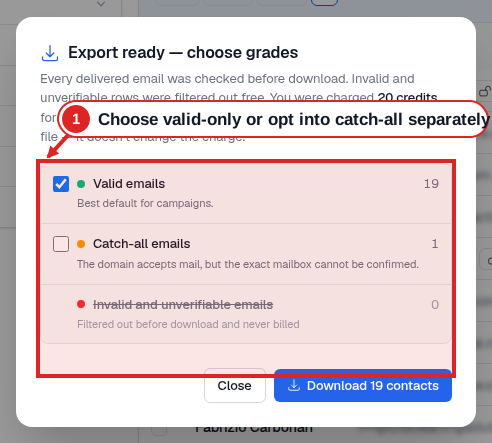
Source evidenceArgorant export summary separating exportable valid contacts from other verification outcomes.Show capture
Argorant export summary separating exportable valid contacts from other verification outcomes.
What you can see here: A usable decay process keeps valid, invalid, catch-all, and unknown as distinct timestamped states instead of one blended score. View the public Argorant export status summary source · captured August 20, 2026
1

Decay is a state transition, not one percentage

People change jobs, domains are replaced, mailboxes are disabled, and receiving infrastructure changes its response. A record can move from valid to invalid, valid to catch-all, or valid to unknown. Unknown can also reflect a temporary inability to obtain a decisive SMTP response rather than a dead mailbox.

A useful decay system stores the prior state, new state, timestamps, verifier, response reason, and intended use. That makes a recheck auditable and prevents repeated calls immediately after a stable result.

2

What the 23 percent figure does and does not prove

ZeroBounce says its 2026 report is based on 11 billion addresses submitted during 2025: more than 2.6 billion invalid, more than 1 billion catch-all, and 62 percent valid. Because customers choose which lists to submit, the dataset can overrepresent old, risky, or uncertain lists.

Use the report as evidence that decay and non-valid states are operationally material. Do not use it to claim that every B2B list loses exactly 23 percent per year or that a specific provider has that error rate.

3

A risk-based verification schedule

Verify immediately before the first paid export or campaign. Reverify reused campaign files when the previous result is older than the risk window. Shorten that window for older scraped lists, job-change-heavy roles, catch-all domains, or campaigns where a bounce has high reputational cost.

Cache stable results to avoid unnecessary repeated verification, but define a time-to-live and invalidate the cache when the underlying record, domain, or provider evidence changes.

Suggested operating windows

SituationActionWhy
New exportVerify immediately before releaseSource presence is not current mailbox proof
Recently verified validReuse inside the documented TTLAvoid unnecessary repeat calls
Old campaign fileReverify before reuseMailbox and job state may have changed
Catch-allSeparate risk laneDomain accepts broadly; mailbox certainty remains limited
UnknownRetry slowly, then keep out of valid-onlyTemporary or policy-driven SMTP ambiguity is possible

Methodology and limitations

External decay figures are quoted only with ZeroBounce's published denominator and sampling caveat. Operational recommendations distinguish valid, invalid, catch-all, risky, and unknown rather than collapsing them into a binary bounce prediction.

Scheduled refresh: quarterly

Public sources

Pricing and product terms can change. Every source links to the public page and shows the review date.

Frequently asked questions

Does an email remain valid forever?

No. Valid is a timestamped observation under a particular verifier and receiving-domain response.

Is unknown the same as invalid?

No. Unknown means the verifier could not reach a decisive mailbox-level result. It still should not enter a valid-only campaign.

Continue your research

Stop paying enterprise prices for data that bounces.

565.8M contacts, verified before you export. Free to start — no annual contract.

Loved by revenue teams
We've gotten 16.81% in replies after working with you guys. Can only recommend you.
Jannik Linke, Founder & CEO, Clementine Media · Germany