Argorant
Argorant
2026 data-quality benchmark

State of B2B data quality 2026: a verification-status benchmark

A reproducible 21,641-record benchmark across industries, with valid, invalid, catch-all, and unknown outcomes kept separate.

Reviewed and updated August 20, 2026 by Argorant

Direct answer

In a systematic sample of 26,988 completed verification records, 21,641 matched a current Argorant industry record and entered the industry table below. Validity varied materially by segment, but unknown and catch-all were often as important as explicit invalid outcomes. These are pre-send verifier statuses, not observed campaign bounce rates.

Our recommendation

Do not publish one universal accuracy or bounce percentage. Measure valid, invalid, catch-all, and unknown separately by source, industry, country, role, verifier, and date. Use only valid in a valid-only campaign; investigate changes in unknown and catch-all rates before changing sender policy.

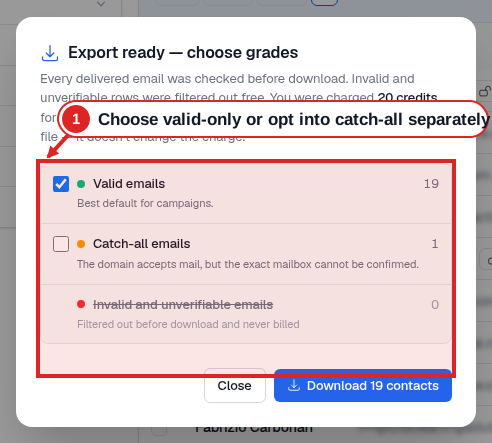
Source evidenceArgorant export summary separating exportable valid contacts from other verification outcomes.Show capture
Argorant export summary separating exportable valid contacts from other verification outcomes.
What you can see here: The reporting model keeps mailbox-level verifier outcomes separate; the industry benchmark uses the same four-state discipline. View the public Argorant export status summary source · captured August 20, 2026
1

How the benchmark was built

The sample selected completed rows where queue_id modulo 101 equaled zero from the production verification queue. That produced 26,988 unique email-status pairs. We joined them to the current contact index by normalized work email; 21,641, or 80.2 percent, matched a current record with usable industry evidence.

Industries were grouped by documented keyword rules into broad reporting categories. A record can contain more than one source industry; the first matching reporting rule assigns the row to one category so denominators remain additive.

2

Why these are not bounce-rate claims

A verifier outcome is measured before send. A bounce is an event returned by a recipient system after send, and it can include policy, reputation, throttling, content, or infrastructure causes beyond mailbox existence. Converting the invalid column directly into a predicted bounce rate would be false precision.

Financial services and professional-services samples show especially high unknown shares. That may reflect receiving-domain policy, verifier visibility, or source composition. It does not prove that those mailboxes are dead.

3

How to use the table

Use the table to size verification workload and to detect status-mix drift. Re-run the same query every quarter, publish the denominator, and compare like with like. For a provider benchmark, hold the input list and verifier set constant.

Historical operator-supplied tests of Apollo and ZoomInfo exports are discussed separately because they used vendor-specific samples and multiple verifiers. They are not mixed into this production-queue industry table.

Verification status by broad industry

IndustryMatched sampleValidInvalidCatch-allUnknown
Software & IT5,00125.9%22.2%21.7%30.2%
Manufacturing2,89027.2%17.6%17.5%37.7%
Financial services1,70911.1%16.9%14.2%57.8%
Healthcare1,66726.3%19.7%18.0%36.0%
Media & marketing1,60623.7%24.4%20.9%31.0%
Retail & consumer1,36425.1%21.8%19.3%33.8%
Professional services1,01818.9%18.0%11.7%51.5%
Construction & real estate70820.2%13.0%15.7%51.1%
Logistics & transport41729.3%16.3%18.0%36.5%
Energy & utilities39227.0%19.9%12.0%41.1%
Education36325.6%25.9%16.8%31.7%

Systematic production-queue sample captured 20 August 2026. Percentages are shares of the matched sample in each row and may not sum to exactly 100.0 because of rounding.

Methodology and limitations

Read-only query run 20 August 2026. Selection: completed verify_queue records with queue_id mod 101 = 0. Join: normalized email to contacts_search_v2. Sample 26,988; joined 21,641; coverage 80.2 percent. Reporting groups are deterministic keyword buckets. No campaign-send or bounce-event data was used.

Scheduled refresh: quarterly

Public sources

Pricing and product terms can change. Every source links to the public page and shows the review date.

Frequently asked questions

Can I call the invalid share a bounce rate?

No. It is a pre-send verification outcome. Report campaign bounce events separately with sender, domain, and response-code context.

Why are unknown results kept separate?

Unknown records lack a decisive mailbox result. Combining them with invalid would overstate failure; combining them with valid would overstate deliverability.

Continue your research

Stop paying enterprise prices for data that bounces.

565.8M contacts, verified before you export. Free to start — no annual contract.

Loved by revenue teams
We've gotten 16.81% in replies after working with you guys. Can only recommend you.
Jannik Linke, Founder & CEO, Clementine Media · Germany