Best B2B Data for Commercial Lenders and Brokers (2026)
Commercial lending data spans three different jobs: finding businesses that fit a credit box, spotting financing signals, and reaching borrowers, introducers, or capital providers. A useful comparison keeps prospecting separate from underwriting.
By Argorant
Reviewed and updated August 20, 2026 by Argorant
Find the reason to call, then reach the borrower or introducer
Use RelPro, S&P Global, DataGardener, or a CRE specialist when financing events, liens, charges, property data, lender appetite, or relationship intelligence determine priority. Use Argorant to map a broad borrower or introducer universe and reach owners, CFOs, Finance Directors, and advisers with verified business contacts. Contact data can support origination, but it cannot certify eligibility or creditworthiness.
Do not compare unlike data products as one category
The right shortlist depends on the job the data must complete. These lanes can form one stack, but a specialist signal, a research database, and a verified-contact layer should not receive the same score for different work.
Map serviceable businesses and the people who control finance or referrals.
Prioritize prospects using liens, charges, maturity, property, funding, or growth events.
Assess the application after a qualified opportunity enters the credit process.
The workflow this data must support
- 1Encode the credit box using sector, geography, size, age, property, and prohibited-sector rules.
- 2Build the eligible-looking origination universe without describing it as approved or creditworthy.
- 3Layer on loan, lien, charge, maturity, property, growth, or funding signals where specialist sources support them.
- 4Identify the owner, CFO, Finance Director, Treasurer, introducer, or lender contact for the specific motion.
- 5Verify and export the business contact with the source and prioritization reason attached.
- 6Pass qualified opportunities into KYC, AML, affordability, and underwriting systems rather than treating prospecting data as a credit decision.
Company filters
- Industry and NAICS or equivalent classification
- Country, region, and lending footprint
- Revenue, headcount, age, and ownership proxies
- Property and asset type
- UCC, charge, loan maturity, growth, and funding signals
People and roles
- Owner
- Managing Director
- Chief Financial Officer
- Finance Director
- Treasurer
- Accountant, broker, or adviser as introducer
- Lender originator or relevant capital-provider contact
Exclusions
- Prohibited sectors
- Companies outside the credit box or lending footprint
- Consumers and personal-email records
- Current customers when the campaign is acquisition-only
- Suppressed and opted-out contacts
Provider comparison
Vendor-published counts and performance statements are labelled as vendor claims. The decisive question is whether the product completes this audience's workflow on a fixed, reproducible sample.
| Provider | Category | Best for | What it does | Decisive limitation |
|---|---|---|---|---|
| Argorant | Borrower and introducer contact execution | Lenders and brokers with a clear credit box that need broad business and decision-maker coverage. | Argorant maps companies by sector, size proxy, and geography, then resolves owner, finance, and introducer roles for verified contact export. | It is not a credit bureau, underwriting system, KYC provider, or proof that a business needs finance. |
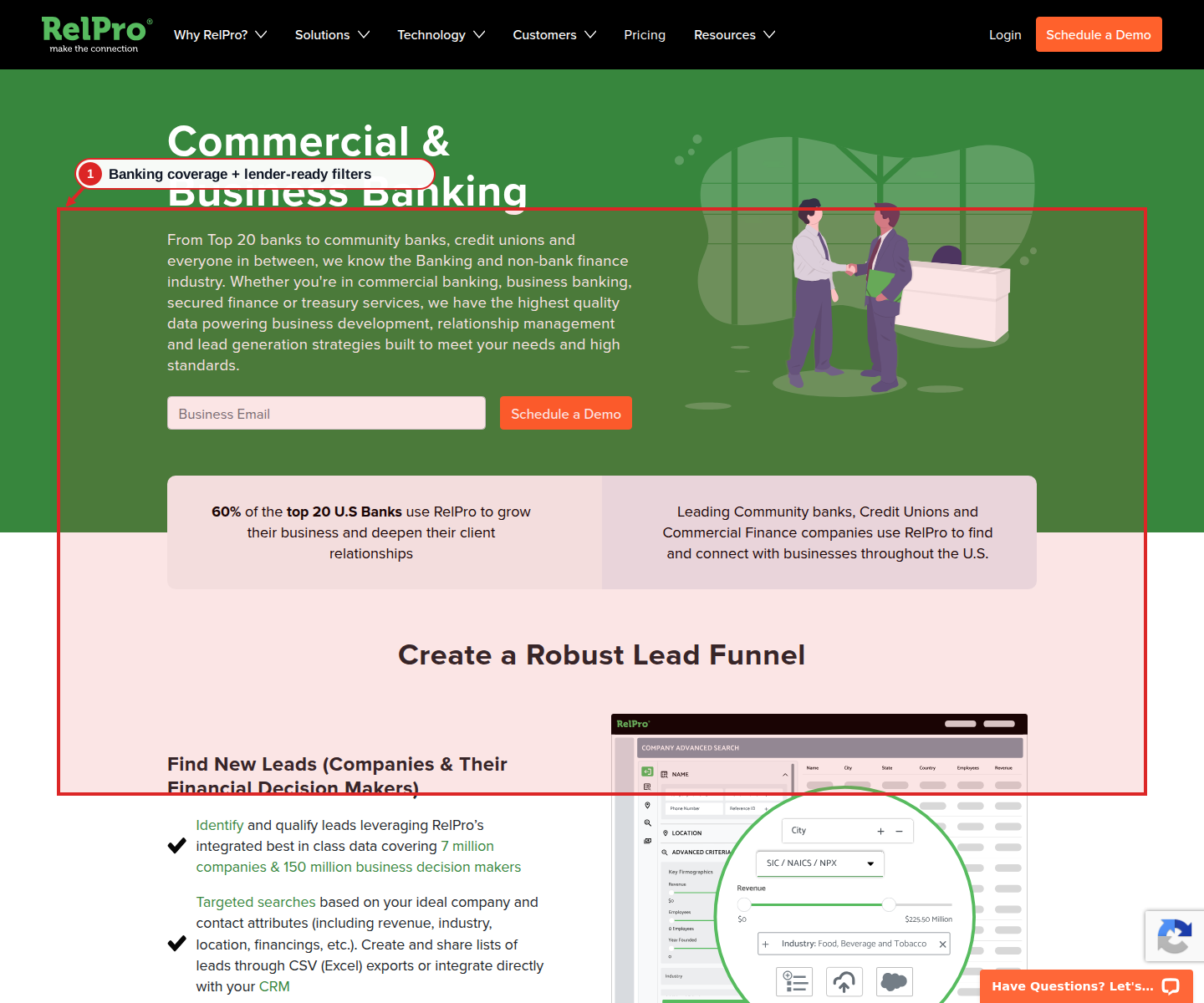
| RelPro | Commercial banking relationship and origination intelligence | Banks and commercial finance teams that need contacts, centers of influence, financing context, alerts, and CRM enrichment. | RelPro combines company and executive data with relationship context, business events, intent, filings, loans, and banking-specific research workflow. | It is a specialist sales-intelligence platform with sales-led onboarding, not a simple metered contact source. |
| S&P Global Commercial Prospecting | U.S. property and lien dataset | U.S. CRE and C&I teams that prioritize opportunities from property, loan, creditor, debtor, and UCC context. | S&P's Commercial Prospecting dataset is built around commercial property and UCC lien records. It answers a financing-event question that a normal people database cannot. | The dataset covers the U.S. only and is not a global contact or underwriting product. |
| DataGardener | UK lending intelligence | UK lenders and commercial finance brokers that need accounts, charges, lender context, and borrower contact data. | DataGardener combines UK company accounts and charge records with filtering and contact access for commercial-lending origination. | Its company-account quantity and coverage statements are vendor claims, and its UK focus should not be generalized to other markets. |
| Capitalize | CRE lender and borrower intelligence | Commercial real-estate brokers and lenders that need lender appetite, loan comps, property signals, and matching workflow. | Capitalize is a specialist CRE layer for finding lenders, matching deals, monitoring property and borrower signals, and reaching relevant lender contacts. | Its specialist CRE workflow does not replace broad commercial borrower coverage outside real estate. |
What the public product page shows
This full-context capture highlights the product detail that matters for this buyer. The source remains linked below the image so you can verify mutable claims on the current public page.
Source evidenceRelPro commercial-banking page showing lead coverage claims and advanced company filters.Show captureHide capture
The strongest commercial-lending stack uses specialist data to establish why a financing conversation may be timely, then uses verified contact data to reach the borrower, introducer, or lender. Keep prospecting, compliance, and underwriting as separate gates. A well-filtered company can be a sensible lead without being an approved borrower.
Frequently asked questions
Can B2B data tell us whether a company is creditworthy?
No. B2B prospecting data can help define and prioritize a borrower universe. Creditworthiness requires the lender's underwriting, bureau, financial, KYC, AML, and policy checks.
Which signals are useful for commercial-lending origination?
The useful signal depends on the product. Examples include UCC filings, charges, property loans, maturity windows, funding, expansion, hiring, asset type, and known lender appetite. None proves demand on its own.
Should brokers target borrowers or introducers?
Many successful origination models do both. Borrower outreach creates direct opportunities. Accountant, broker, adviser, and referral-partner outreach builds a recurring source of qualified introductions.
How should lenders compare data costs?
Compare cost per qualified, reachable opportunity after geography, credit-box proxy, signal relevance, contact verification, duplication, and suppression. Raw records and nominal credits are weak denominators.
Sources reviewed
Each source links to the vendor's current public product or documentation page. Vendor counts and performance statements remain attributed claims, not independent audit results.
6 sources checked and datedShow sources
Test the market definition
before buying the list.
Count and preview the segment, then reveal or export verified contacts only after the criteria hold up.