Les fournisseurs de données B2B, comparés honnêtement.
Every vendor claims the biggest database and the best accuracy. Both claims are unfalsifiable as stated. Here’s a framework that replaces them with questions you can actually test, including on us.
By Argorant
Reviewed and updated August 20, 2026 by Argorant
Why headline numbers mislead
The category sorts itself by total record count: ZoomInfo and Apollo each advertise databases in the hundreds of millions, Cognism leads with European depth, Lusha and Hunter with simplicity, and Argorant’s own number is 630.7M contacts across 202 countries. None of these figures, including ours, answers the question you’re actually asking: whether the database covers the eight thousand companies you sell to, with mailboxes that still exist. A vendor can lead a global count and be thin in mid-market German manufacturing; a smaller database can be dense exactly where you operate. Total size tells you about the vendor’s collection ambitions, not your hit rate.
So the first rule of evaluation: ignore the brochure and test coverage against your real market. The rest of this guide is the checklist for doing that, in the order the questions matter.
Current pricing and access map
A useful comparison needs the monthly price, the annual monthly equivalent, the included usage, and the programmatic-access rule. The snapshots below were checked on August 20, 2026. They are not affiliate summaries. Each card links to the vendor page used.
- Essai gratuit de 7 jours avec 100 crédits.
- Starter : $99/mois, ou $79/mois en facturation annuelle (5,000 contacts).
- Pro : $249/mois, ou $199/mois en facturation annuelle (25,000 contacts).
Idéal quand l'acheteur veut des limites transparentes, une recherche de contacts à fort volume, des contrôles d'export et un accès pour agents IA sans passer par un devis.
- Forfait Free : $0 avec 900 crédits par place et par an.
- Basic : $65 au mois avec 2,500 crédits mensuels, ou $49 par place/mois en facturation annuelle avec 30,000 crédits annuels.
- Professional : $99 au mois avec 4,000 crédits mensuels, ou $79 par place/mois en facturation annuelle avec 48,000 crédits annuels.
Idéal quand l'équipe veut les données de prospection et le workflow outbound dans un seul espace. Moins ciblé si l'acheteur a seulement besoin de données vérifiées et d'un usage flexible de l'export ou du MCP.
- Free inclut 50 crédits par mois et des utilisateurs illimités.
- Starter : $49 au mois pour 2,000 crédits mensuels, ou équivalent mensuel de $34 avec 24,000 crédits annuels.
- Growth : $149 au mois pour 10,000 crédits mensuels, ou équivalent mensuel de $104 avec 120,000 crédits annuels.
Idéal quand la découverte et la vérification d'e-mails sont le besoin principal. Argorant est plus fort quand l'intelligence entreprise, la profondeur de contacts, les exports et l'usage par des agents comptent davantage.
- Free inclut 40 crédits mensuels. En facturation annuelle, Starter est à $37.45/mois pour 4,800 crédits annuels, Pro à $48.95 pour 7,200, et Premium à $259.95 pour 40,800.
- Les prix catalogue au mois sont de $49.90 pour Starter, $69.90 pour Pro et $399.90 pour Premium ; Scale reste sur mesure.
- Selon les règles publiées, un e-mail vérifié coûte 1 crédit, un téléphone 5, et les lots de résultats CSV/API de 1 à 25 lignes coûtent 1 crédit.
Comparez le même workflow sur les actions e-mail, téléphone, API, CSV et IA. Un solde unique est simple, mais le coût par résultat utile change fortement quand un téléphone coûte cinq fois un e-mail.
- Essai gratuit : $0 pendant 7 jours avec 5 crédits.
- Essentials : $99 au mois pour 170 crédits mensuels, ou équivalent mensuel de $74 avec 2,040 crédits annuels.
- Plus : $199 au mois pour 400 crédits mensuels, ou équivalent mensuel de $149 avec 4,800 crédits annuels.
Les acheteurs doivent comparer les crédits, le prix des crédits supplémentaires, les téléphones vérifiés, l'accès API et les workflows d'export avec les cas d'usage à fort volume de contacts d'Argorant.
- Free : $0 pour un utilisateur avec 50 crédits.
- Au réglage mensuel minimum de 200 crédits, Pro coûte $20 au mois ou $15/mois en facturation annuelle pour 2,400 crédits annuels, avec jusqu'à cinq utilisateurs.
- Le curseur en direct monte à 6,750 crédits mensuels pour $290.25 au mois ou $217.69/mois en facturation annuelle ; Enterprise reste sur mesure et uniquement annuel.
Bon choix si l'équipe veut le workflow commercial et le connecteur Claude de LeadIQ. Comparez le coût par résultat exploitable, car le prix du curseur change avec les crédits et le MCP utilise le même solde du forfait authentifié.
- Essentials : équivalent $33/mois, $399 facturés à l'année, avec 100 recherches mensuelles et des données e-mail uniquement.
- Pro : équivalent $75/mois, $899 facturés à l'année, avec 250 recherches mensuelles et e-mail plus téléphone.
- Ultimate : équivalent $142/mois, $1,699 facturés à l'année, avec 1,000 recherches mensuelles, e-mail plus téléphone et accès API.
Forte surface de découverte publique et workflows navigateur. Les acheteurs doivent comparer les limites d'export annuelles, les options de recherche, l'accès aux mobiles et la facturation d'équipe aux besoins à plus fort volume couverts par Argorant.
- ZoomInfo Lite est un niveau d'entrée gratuit permanent avec 10 crédits mensuels ; Community Edition porte cette allocation à 25.
- Les forfaits Enterprise restent sur devis et généralement annuels ; les fourchettes indépendantes, ramenées au mois, donnent environ $1,250-$3,750+ par mois pour une offre de base et $2,500-$5,000 tout compris.
- GTM AI démarre avec 1,000 crédits de données et 1,000 crédits IA, recherche et consultation gratuites, et des recharges à partir de $20 ; le tarif de lancement du crédit de données est de $0.10 contre un prix catalogue annoncé de $0.35.
Fort pour l'intelligence GTM large et les signaux intégrés. L'allocation mensuelle de 10 crédits de Lite est une voie de test, pas un forfait opérationnel à fort volume.
- Standard et Pro incluent chacun cinq places, mais sont présentés sans prix publics en dollars.
- L'enrichissement CRM et le Data-as-a-Service sont présentés comme des options ou des achats distincts.
- Un crédit débloque, enrichit ou exporte un contact ; les mêmes crédits fonctionnent sur la plateforme, Enrich et l'API.
Fort pour les équipes grands comptes qui apprécient la couverture EMEA et un achat géré. Argorant est plus fort quand un accès transparent aux données, des exports à fort volume et des workflows natifs pour les agents comptent le plus.
What the published plan pages actually show
Screenshots are useful only when the highlighted claim is visible and the live source is linked. These two examples show why the sticker price alone is insufficient: UpLead moves full API access into an annual custom plan, while LeadIQ publishes both MCP and API access but says its Claude connector consumes normal paid-plan credits.
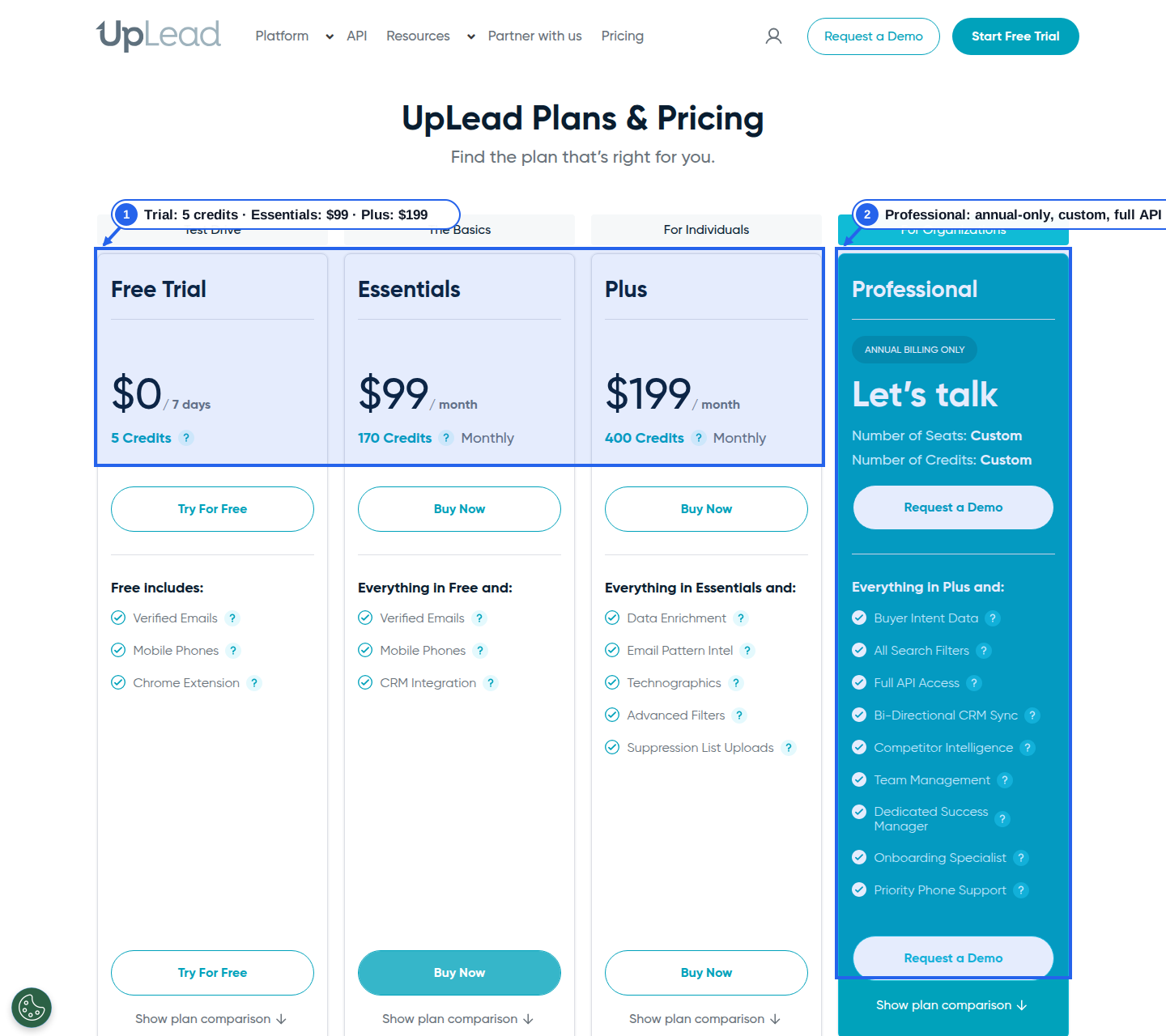
- 1Trial: 5 credits · Essentials: $99 · Plus: $199
UpLead's monthly view shows a seven-day five-credit trial, Essentials at $99 for 170 monthly credits, and Plus at $199 for 400 monthly credits.
- 2Professional: annual-only, custom, full API
The Professional card is annual-only, uses custom seats and credits, and lists full API access.
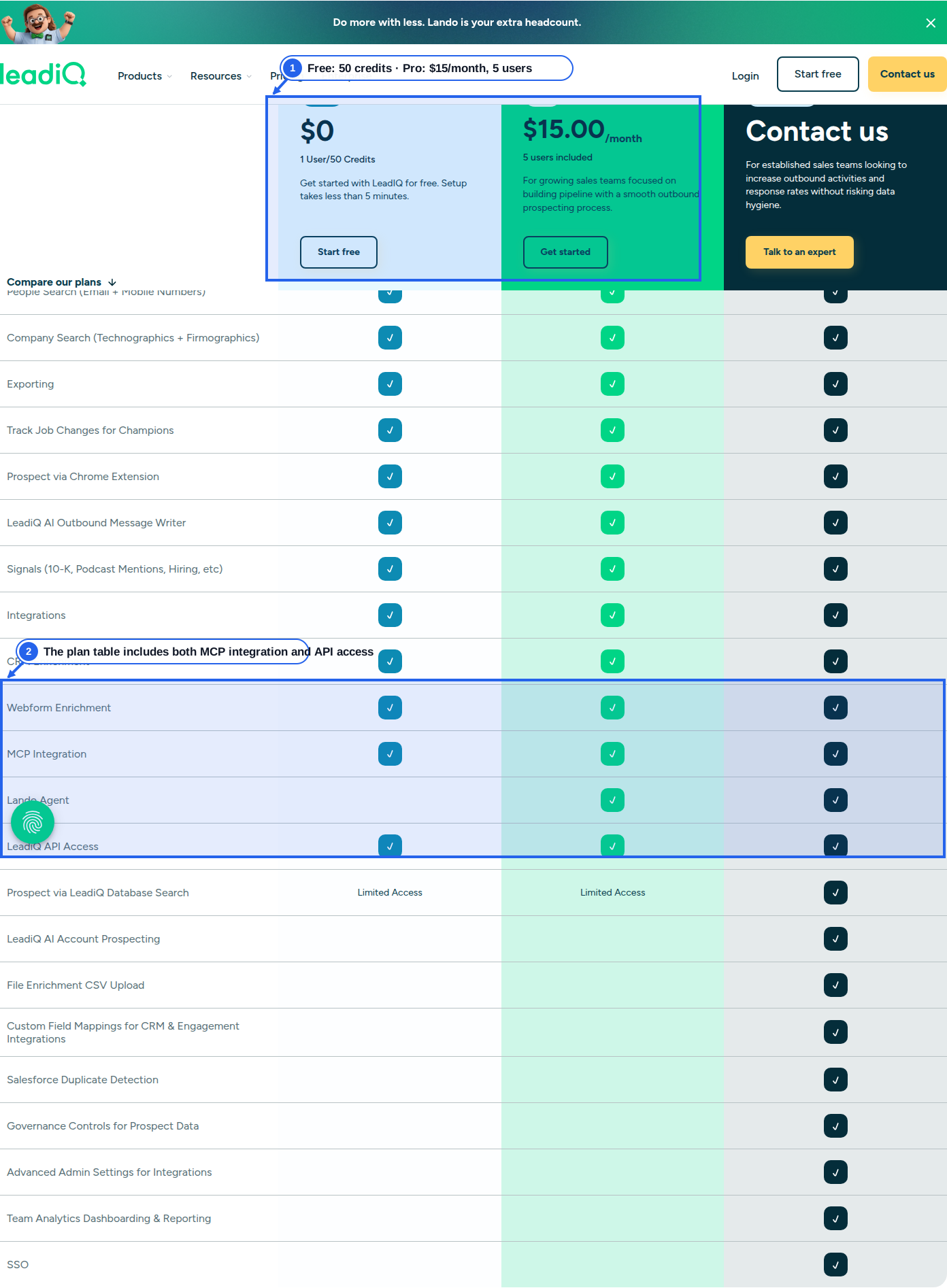
- 1Free: 50 credits · Pro: $15/month, 5 users
In the selected annual view, Free includes one user and 50 credits while the minimum Pro setting shows $15 per month and up to five users.
- 2The plan table includes both MCP integration and API access
LeadIQ's public comparison table lists MCP integration and API access; separate Claude documentation says live company and contact access requires an active paid subscription and consumes normal credits.
1. Coverage against your actual ICP
Take your genuine ICP filters, including industry, headcount, geography, and title, and run the identical search in every platform you’re evaluating, on a trial or free tier, before any contract discussion. Record three numbers: matching companies, matching contacts with emails, and (by sampling) how many of those companies are really in your segment versus misclassified. Then check ten accounts you know well, including current customers and dream logos, and see whether the right people show up at each. An afternoon of this produces a coverage table no analyst report can give you, because no analyst has your ICP. Geography deserves special attention: providers differ far more outside the US than inside it, and EU/DACH/APAC depth varies enormously between vendors that look identical on a US-only test.
2. Verification methodology and timing
“95%+ accuracy” appears on nearly every site in the category and means nothing without two qualifiers: how was the verdict produced, and when. Methodologies range from pattern inference (guessing first.last@) through MX-level checks to live per-mailbox SMTP probes. Each method answers a different question and can return a different status. Timing matters just as much: a verdict created when a record entered the database may no longer describe the mailbox at export. Ask every vendor: do you SMTP-probe per mailbox? At collection or at export? How are catch-all domains labeled, as their own category, or folded into “valid” to flatter the accuracy stat? A vendor that can’t answer per-row “when was this verified?” is selling you the past. Our own answers are documented publicly in notre méthode de vérification, and the underlying mechanics are in our verification guide.
Our historical export test, with its limits
In Argorant’s internal export tests, Apollo’s invalid share ranged from 39% to 48%, while ZoomInfo ranged from 31% to 38%. One run returned 46.21% for Apollo and approximately 34.6% for ZoomInfo. These figures describe the tested exports, not either vendor’s full database.
| Export source | Invalid range | One observed run |
|---|---|---|
| Apollo | 39% to 48% | 46.21% |
| ZoomInfo | 31% to 38% | Approximately 34.6% |
Methodology limitation: the historical raw exports, per-verifier confusion matrix, segment composition, and exact status mapping are not currently published. Invalid, catch-all, unknown, and risky results must be kept separate in any new benchmark.
3. Pricing motion: self-serve versus quote-led
The buying experience predicts the contract. Self-serve vendors (Apollo, Hunter, Lusha, Argorant) publish prices, let you start without talking to anyone, and bill monthly. Quote-led vendors (ZoomInfo, Cognism, and most enterprise platforms) route you through sales, price by negotiation, and typically require annual commitments, frequently five figures before the platform has proven anything against your ICP. Neither motion is wrong; they optimize for different buyers. But be honest about which one fits your stage: a quote-led annual contract is a bet placed before the coverage test, while self-serve lets the product fail fast on its own merits. If a vendor won’t show pricing without a call, price that opacity into your evaluation.
4. The credit fine print: seats, exports, expiry
Two plans with the same sticker can differ several-fold in effective cost once you read the metering. The questions that matter: Are credits pooled across the team or trapped per seat? Do unused credits roll over or expire monthly? Is a credit charged for viewing a contact, or only for exporting it? Are bulk CSV exports on your plan, or gated to a higher tier (a common ceiling on entry-level plans)? And, decisive if you read section 2, do you pay for records that turn out to be invalid? Most per-record pricing charges the same for a live mailbox and a dead one, which means the vendor monetizes its own decay. The alternative model, which Argorant uses, is pay-per-deliverable: invalid and unverifiable rows are filtered at export and cost zero credits, so the freshness risk sits with the seller.
5. API and agent access
Increasingly, the entity running searches isn’t a person with a browser. It’s a workflow, a CRM sync, or an AI agent. That makes programmatic access a first-class criterion. Check whether the API is included or an enterprise upsell, what the rate limits are at your tier, and whether the full workflow (search, count, preview, export) is exposed or just lookup endpoints. If your team uses Claude, GPT, or custom agents, ask specifically about MCP support. It’s the difference between an agent that operates the database natively and one that scrapes a UI. Argorant ships MCP and API on every paid plan, plus a CLI on npm (npx argorant); for most legacy vendors, equivalent access starts at enterprise tiers. See Accès pour agents IA for what that looks like in practice.
6. Contract terms and exit cost
Read for the exit before you sign the entrance. Annual commitment or monthly? Auto-renewal with a narrow cancellation window? Seat-count minimums? What happens to exported data if you leave? Most vendors license rather than sell records, and the license terms on departure vary widely. Also check compliance posture (GDPR handling, a signable DPA, a documented opt-out process for data subjects), because your outbound program inherits your data vendor’s legal standing. None of this shows up in a demo, all of it shows up in year two.
The metric that decides it: cost per usable contact
Collapse everything above into one number. Take a real segment from your ICP, export it (or its equivalent) from each finalist, verify the output independently if the vendor didn’t verify at export, and divide the true monthly cost by the count of contacts that are in-segment and deliverable. That’s cost per usable contact, and it routinely reorders the field: a platform with a low sticker and 30% dead rows is more expensive than one that charges more per credit but only for valid records. It also converts every vendor claim into something testable on a few hundred rows.
Where does Argorant sit in this framework? Deliberately narrow. We don’t ship intent data, a built-in dialer, or org-chart visualizations. Vendors like ZoomInfo, Apollo, and Cognism bundle far more workflow. What we do is the contact layer itself, done strictly: 630.7M contacts in 202 countries, every work email checked live at download, catch-alls opt-in, invalid rows free, plans from under $100/month with API, MCP, and CLI access on every paid plan, plus a prepaid agent wallet at $0.035 per contact without a subscription. If you need the full platform bundle, buy the bundle. If you need verified contacts at a testable cost per usable row, run us through this exact framework. The side-by-side breakdowns live in compare and alternatives, and the numbers are on pricing.
Run the framework
on us first.
Test coverage on your real ICP with a personalized 25-lead sample and pay only for deliverable contacts.