B2Bデータプロバイダーを、公正に比較。
Every vendor claims the biggest database and the best accuracy. Both claims are unfalsifiable as stated. Here’s a framework that replaces them with questions you can actually test, including on us.
By Argorant
Reviewed and updated August 20, 2026 by Argorant
Why headline numbers mislead
The category sorts itself by total record count: ZoomInfo and Apollo each advertise databases in the hundreds of millions, Cognism leads with European depth, Lusha and Hunter with simplicity, and Argorant’s own number is 630.7M contacts across 202 countries. None of these figures, including ours, answers the question you’re actually asking: whether the database covers the eight thousand companies you sell to, with mailboxes that still exist. A vendor can lead a global count and be thin in mid-market German manufacturing; a smaller database can be dense exactly where you operate. Total size tells you about the vendor’s collection ambitions, not your hit rate.
So the first rule of evaluation: ignore the brochure and test coverage against your real market. The rest of this guide is the checklist for doing that, in the order the questions matter.
Current pricing and access map
A useful comparison needs the monthly price, the annual monthly equivalent, the included usage, and the programmatic-access rule. The snapshots below were checked on August 20, 2026. They are not affiliate summaries. Each card links to the vendor page used.
- 100クレジット付きの7日間無料トライアル。
- Starter:月$99、または年払いで月$79(5,000コンタクト)。
- Pro:月額$249、年払いなら月額$199(25,000コンタクト)。
見積もりのみの出発点ではなく、透明な上限、大量のコンタクト検索、エクスポートの制御、AIエージェントからのアクセスを求める買い手に最適。
- Freeプラン:$0で、1シートあたり年間900クレジット。
- Basic:月払いで$65、毎月2,500クレジット。または年払いで1シートあたり月$49、年間30,000クレジット。
- Professional:月払いなら月額$99で月4,000クレジット、年払いなら1シートあたり月額$79で年間48,000クレジット。
見込み顧客のデータとアウトバウンドのワークフローを1つのワークスペースで求めるチームに最適。確認済みのデータと、柔軟なエクスポートやMCPの利用だけが必要な買い手には焦点がずれます。
- Freeには月50クレジットとユーザー数無制限が含まれます。
- Starter:月ごとの契約で$49、毎月2,000クレジット。または月額換算$34で年間24,000クレジット。
- Growth:月払いで$149、月10,000クレジット、または月額換算$104で年間120,000クレジット。
メールアドレスの発見とチェックが主な目的の場合に最適。企業インテリジェンス、コンタクトの充実度、エクスポート、エージェントでの利用が重要なら、Argorantが強みを発揮します。
- Freeには毎月40クレジットが含まれます。年払いでは、Starterが月$37.45で年間4,800クレジット、Proが$48.95で7,200クレジット、Premiumが$259.95で40,800クレジットと記載されています。
- 月払いの表示価格は、Starterが$49.90、Proが$69.90、Premiumが$399.90です。Scaleは個別見積もりのままです。
- 公開されているルールでは、確認済みのメールアドレス1件で1クレジット、電話番号は5クレジット、CSVやAPIの結果は1〜25行のまとまりごとに1クレジットです。
メール、電話、API、CSV、AIの各操作で、同じワークフローを比較してください。残高が1つにまとまっているのはシンプルですが、電話番号がメールアドレスの5倍の費用になると、役に立つアウトプット1件あたりのコストは大きく変わります。
- 無料トライアル:7日間$0、5クレジット付き。
- Essentials:月払いで$99、月170クレジット、または月額換算$74で年間2,040クレジット。
- Plus:月払いなら月額$199で月400クレジット、年払いなら月額換算$149で年間4,800クレジット。
クレジット、追加クレジットの価格、確認済みの電話番号、APIアクセス、エクスポートのワークフローを、Argorantの大量のコンタクト利用のケースと比べてください。
- Free:1ユーザーで$0、50クレジット付き。
- 最小の月200クレジットの設定では、Proは月払いで$20、年払いなら月$15で年間2,400クレジット、最大5ユーザーまで利用できます。
- 現在のスライダーでは、毎月6,750クレジットが月ごとの契約で$290.25、年払いで月$217.69になります。Enterpriseは引き続き個別対応で、年払いのみです。
LeadIQの営業担当者向けワークフローとClaudeのコネクタを求めるチームには良い選択です。スライダーの価格はクレジットによって変わり、MCPも認証済みの同じプランの残高を使うため、使えるアウトプット1件あたりのコストで比較してください。
- Essentials:月額換算$33、年払いで$399、月100回の検索、メールアドレスのデータのみ。
- Pro:月額換算$75、年払いで$899。月250件の検索と、メールアドレスと電話番号を含みます。
- Ultimate:月額換算$142、年払い$1,699。毎月1,000件の検索、メールアドレスと電話番号、APIアクセス付き。
公開されている探索機能とブラウザのワークフローが充実しています。購入を検討する際は、年間のエクスポート上限、検索のアドオン、携帯電話番号へのアクセス、チームの請求方法を、Argorantで想定する大量利用の要件と比べてください。
- ZoomInfo Liteは毎月10クレジットの恒久的な無料プランです。Community Editionではその枠が25に増えます。
- Enterpriseプランは引き続き個別見積もりで、通常は年間契約です。第三者の調査による価格帯を月額に換算すると、基本パッケージでおよそ$1,250〜$3,750+、すべて込みで$2,500〜$5,000です。
- GTM AIは、1,000データクレジットと1,000 AIクレジット、無料の検索と照会、$20からのチャージで始まります。データクレジットのローンチ価格は$0.10で、記載の定価は$0.35です。
幅広いGTMインテリジェンスと統合されたシグナルに強みがあります。Liteの月10クレジットの枠はお試し用で、大量運用のためのプランではありません。
- StandardとProはどちらも5席を含みますが、公開されたドル建ての価格はありません。
- CRMのデータ補完とData-as-a-Serviceは、アドオンまたは別の購入として位置付けられています。
- 1クレジットでコンタクト1件の表示、データ補完、エクスポートができます。同じクレジットをプラットフォーム、Enrich、APIで使えます。
EMEAのカバー率と手厚い購買支援を重視するエンタープライズのチームに向いています。透明性のあるデータアクセス、大量のエクスポート、エージェント対応のワークフローが最も重要な場合は、Argorantのほうが優れています。
What the published plan pages actually show
Screenshots are useful only when the highlighted claim is visible and the live source is linked. These two examples show why the sticker price alone is insufficient: UpLead moves full API access into an annual custom plan, while LeadIQ publishes both MCP and API access but says its Claude connector consumes normal paid-plan credits.
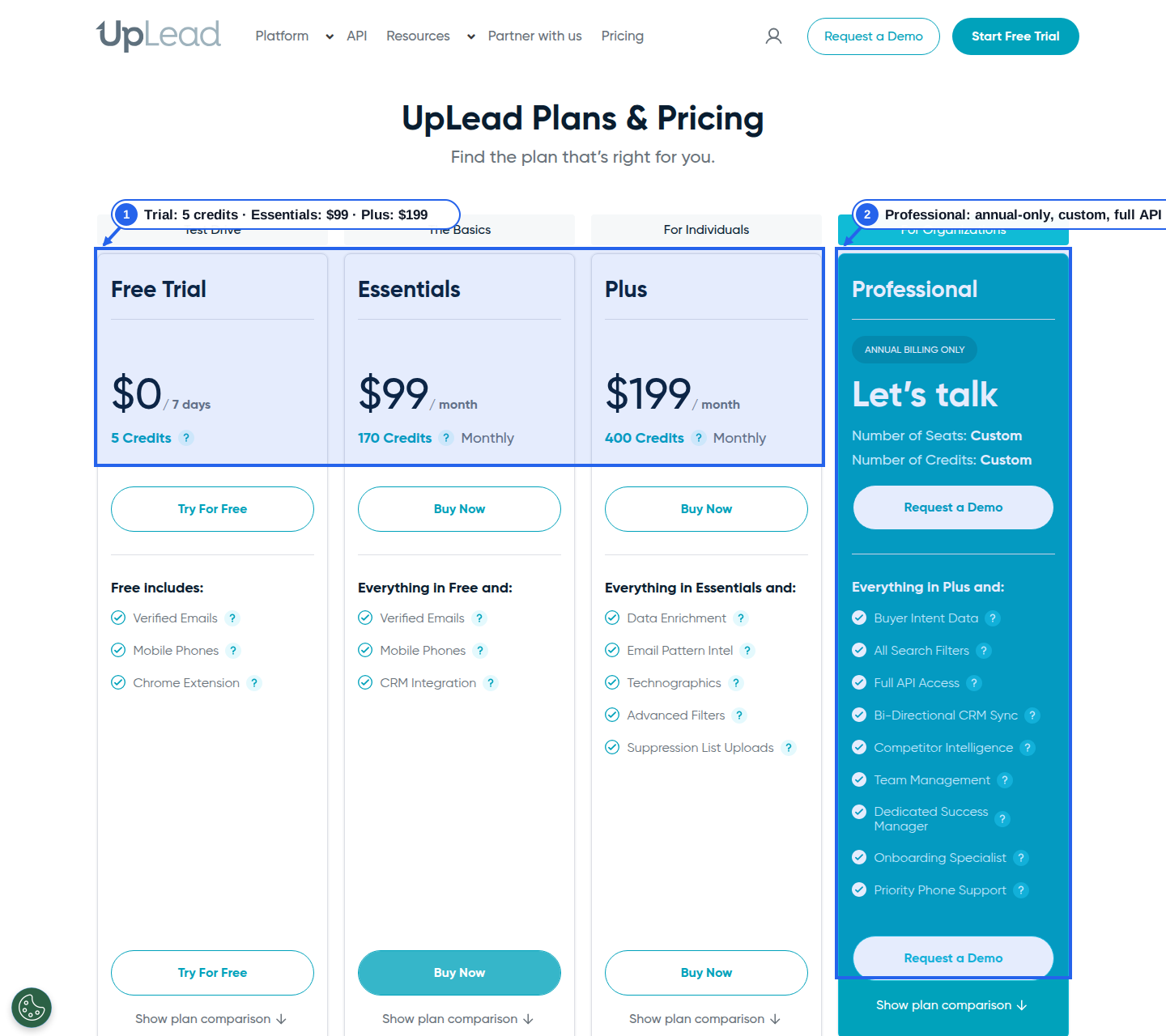
- 1Trial: 5 credits · Essentials: $99 · Plus: $199
UpLead's monthly view shows a seven-day five-credit trial, Essentials at $99 for 170 monthly credits, and Plus at $199 for 400 monthly credits.
- 2Professional: annual-only, custom, full API
The Professional card is annual-only, uses custom seats and credits, and lists full API access.
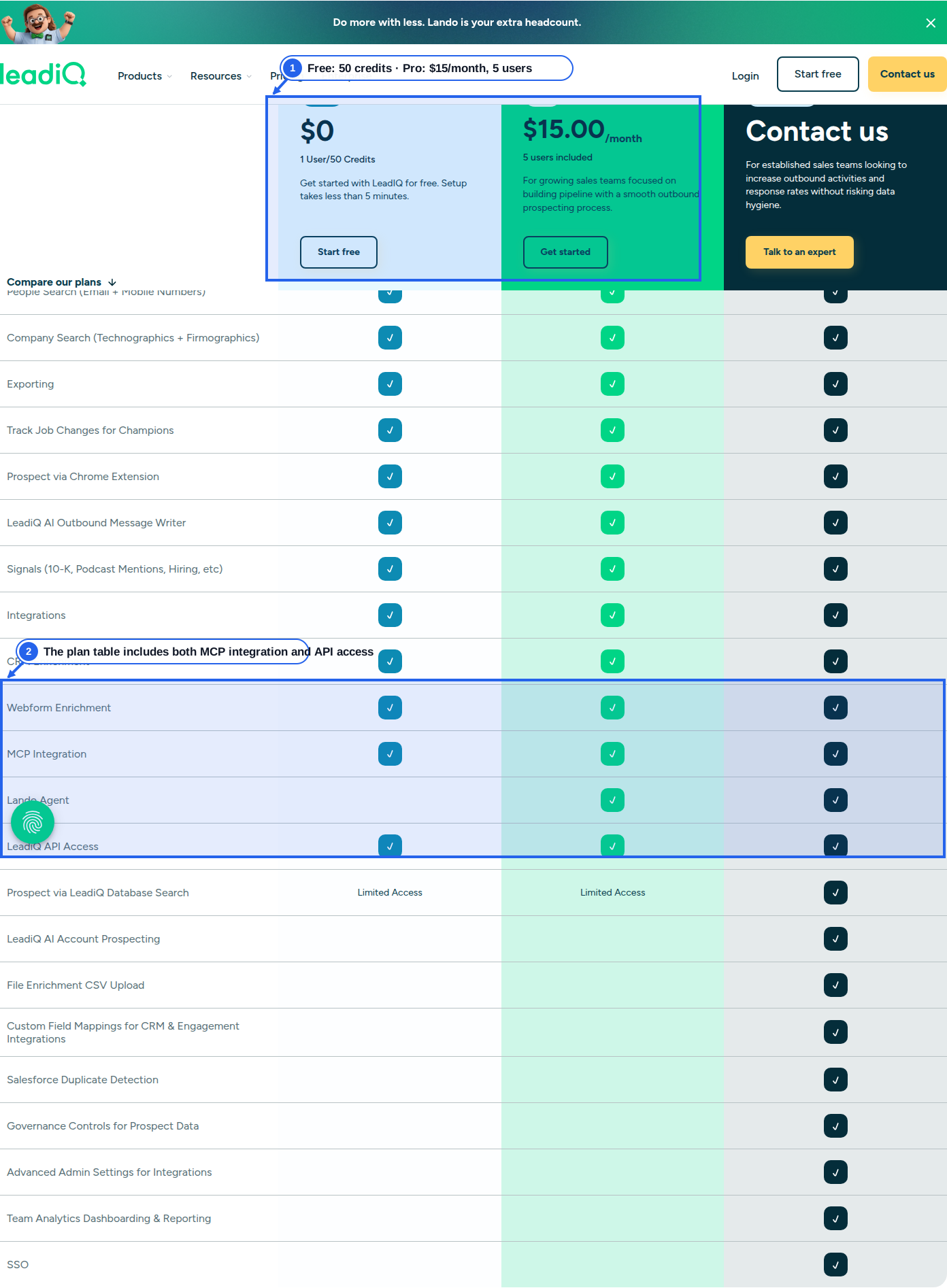
- 1Free: 50 credits · Pro: $15/month, 5 users
In the selected annual view, Free includes one user and 50 credits while the minimum Pro setting shows $15 per month and up to five users.
- 2The plan table includes both MCP integration and API access
LeadIQ's public comparison table lists MCP integration and API access; separate Claude documentation says live company and contact access requires an active paid subscription and consumes normal credits.
1. Coverage against your actual ICP
Take your genuine ICP filters, including industry, headcount, geography, and title, and run the identical search in every platform you’re evaluating, on a trial or free tier, before any contract discussion. Record three numbers: matching companies, matching contacts with emails, and (by sampling) how many of those companies are really in your segment versus misclassified. Then check ten accounts you know well, including current customers and dream logos, and see whether the right people show up at each. An afternoon of this produces a coverage table no analyst report can give you, because no analyst has your ICP. Geography deserves special attention: providers differ far more outside the US than inside it, and EU/DACH/APAC depth varies enormously between vendors that look identical on a US-only test.
2. Verification methodology and timing
“95%+ accuracy” appears on nearly every site in the category and means nothing without two qualifiers: how was the verdict produced, and when. Methodologies range from pattern inference (guessing first.last@) through MX-level checks to live per-mailbox SMTP probes. Each method answers a different question and can return a different status. Timing matters just as much: a verdict created when a record entered the database may no longer describe the mailbox at export. Ask every vendor: do you SMTP-probe per mailbox? At collection or at export? How are catch-all domains labeled, as their own category, or folded into “valid” to flatter the accuracy stat? A vendor that can’t answer per-row “when was this verified?” is selling you the past. Our own answers are documented publicly in メールチェックの方法, and the underlying mechanics are in our verification guide.
Our historical export test, with its limits
In Argorant’s internal export tests, Apollo’s invalid share ranged from 39% to 48%, while ZoomInfo ranged from 31% to 38%. One run returned 46.21% for Apollo and approximately 34.6% for ZoomInfo. These figures describe the tested exports, not either vendor’s full database.
| Export source | Invalid range | One observed run |
|---|---|---|
| Apollo | 39% to 48% | 46.21% |
| ZoomInfo | 31% to 38% | Approximately 34.6% |
Methodology limitation: the historical raw exports, per-verifier confusion matrix, segment composition, and exact status mapping are not currently published. Invalid, catch-all, unknown, and risky results must be kept separate in any new benchmark.
3. Pricing motion: self-serve versus quote-led
The buying experience predicts the contract. Self-serve vendors (Apollo, Hunter, Lusha, Argorant) publish prices, let you start without talking to anyone, and bill monthly. Quote-led vendors (ZoomInfo, Cognism, and most enterprise platforms) route you through sales, price by negotiation, and typically require annual commitments, frequently five figures before the platform has proven anything against your ICP. Neither motion is wrong; they optimize for different buyers. But be honest about which one fits your stage: a quote-led annual contract is a bet placed before the coverage test, while self-serve lets the product fail fast on its own merits. If a vendor won’t show pricing without a call, price that opacity into your evaluation.
4. The credit fine print: seats, exports, expiry
Two plans with the same sticker can differ several-fold in effective cost once you read the metering. The questions that matter: Are credits pooled across the team or trapped per seat? Do unused credits roll over or expire monthly? Is a credit charged for viewing a contact, or only for exporting it? Are bulk CSV exports on your plan, or gated to a higher tier (a common ceiling on entry-level plans)? And, decisive if you read section 2, do you pay for records that turn out to be invalid? Most per-record pricing charges the same for a live mailbox and a dead one, which means the vendor monetizes its own decay. The alternative model, which Argorant uses, is pay-per-deliverable: invalid and unverifiable rows are filtered at export and cost zero credits, so the freshness risk sits with the seller.
5. API and agent access
Increasingly, the entity running searches isn’t a person with a browser. It’s a workflow, a CRM sync, or an AI agent. That makes programmatic access a first-class criterion. Check whether the API is included or an enterprise upsell, what the rate limits are at your tier, and whether the full workflow (search, count, preview, export) is exposed or just lookup endpoints. If your team uses Claude, GPT, or custom agents, ask specifically about MCP support. It’s the difference between an agent that operates the database natively and one that scrapes a UI. Argorant ships MCP and API on every paid plan, plus a CLI on npm (npx argorant); for most legacy vendors, equivalent access starts at enterprise tiers. See AIエージェントからのアクセス for what that looks like in practice.
6. Contract terms and exit cost
Read for the exit before you sign the entrance. Annual commitment or monthly? Auto-renewal with a narrow cancellation window? Seat-count minimums? What happens to exported data if you leave? Most vendors license rather than sell records, and the license terms on departure vary widely. Also check compliance posture (GDPR handling, a signable DPA, a documented opt-out process for data subjects), because your outbound program inherits your data vendor’s legal standing. None of this shows up in a demo, all of it shows up in year two.
The metric that decides it: cost per usable contact
Collapse everything above into one number. Take a real segment from your ICP, export it (or its equivalent) from each finalist, verify the output independently if the vendor didn’t verify at export, and divide the true monthly cost by the count of contacts that are in-segment and deliverable. That’s cost per usable contact, and it routinely reorders the field: a platform with a low sticker and 30% dead rows is more expensive than one that charges more per credit but only for valid records. It also converts every vendor claim into something testable on a few hundred rows.
Where does Argorant sit in this framework? Deliberately narrow. We don’t ship intent data, a built-in dialer, or org-chart visualizations. Vendors like ZoomInfo, Apollo, and Cognism bundle far more workflow. What we do is the contact layer itself, done strictly: 630.7M contacts in 202 countries, every work email checked live at download, catch-alls opt-in, invalid rows free, plans from under $100/month with API, MCP, and CLI access on every paid plan, plus a prepaid agent wallet at $0.035 per contact without a subscription. If you need the full platform bundle, buy the bundle. If you need verified contacts at a testable cost per usable row, run us through this exact framework. The side-by-side breakdowns live in compare and alternatives, and the numbers are on pricing.
Run the framework
on us first.
Test coverage on your real ICP with a personalized 25-lead sample and pay only for deliverable contacts.