
You sell software that shortens the monthly close: invoices, bank lines and cost centres reconciled automatically inside the accounting system the company already runs. Your buyer in Germany, Austria and Switzerland is the CFO, or at companies of 50 to 500 people more often the Kaufmännischer Leiter, the commercial director who owns finance, controlling and often HR as well. This use case finds them, writes to them in German, and turns a yes into a 20 minute call.
- A saved list of about 2,500 finance leads at machinery makers, manufacturers and wholesalers with 51 to 500 employees in Germany, Austria and Switzerland.
- A campaign of three German emails in one thread, formal "Sie" throughout, with one line about each company's setup.
- Mailboxes sized for five weeks of sending, and a subsequence that answers every yes with two call times.
Step 1. Write the sentence first
Ours is this. "Finance leads at machinery makers, manufacturers and wholesalers in Germany, Austria and Switzerland with 51 to 500 employees." The industries are there for a reason. Companies with stock, orders and many supplier invoices feel a slow close the most. A consulting firm of the same size has a fraction of the bookings and a different problem.
Step 2. Set the filters
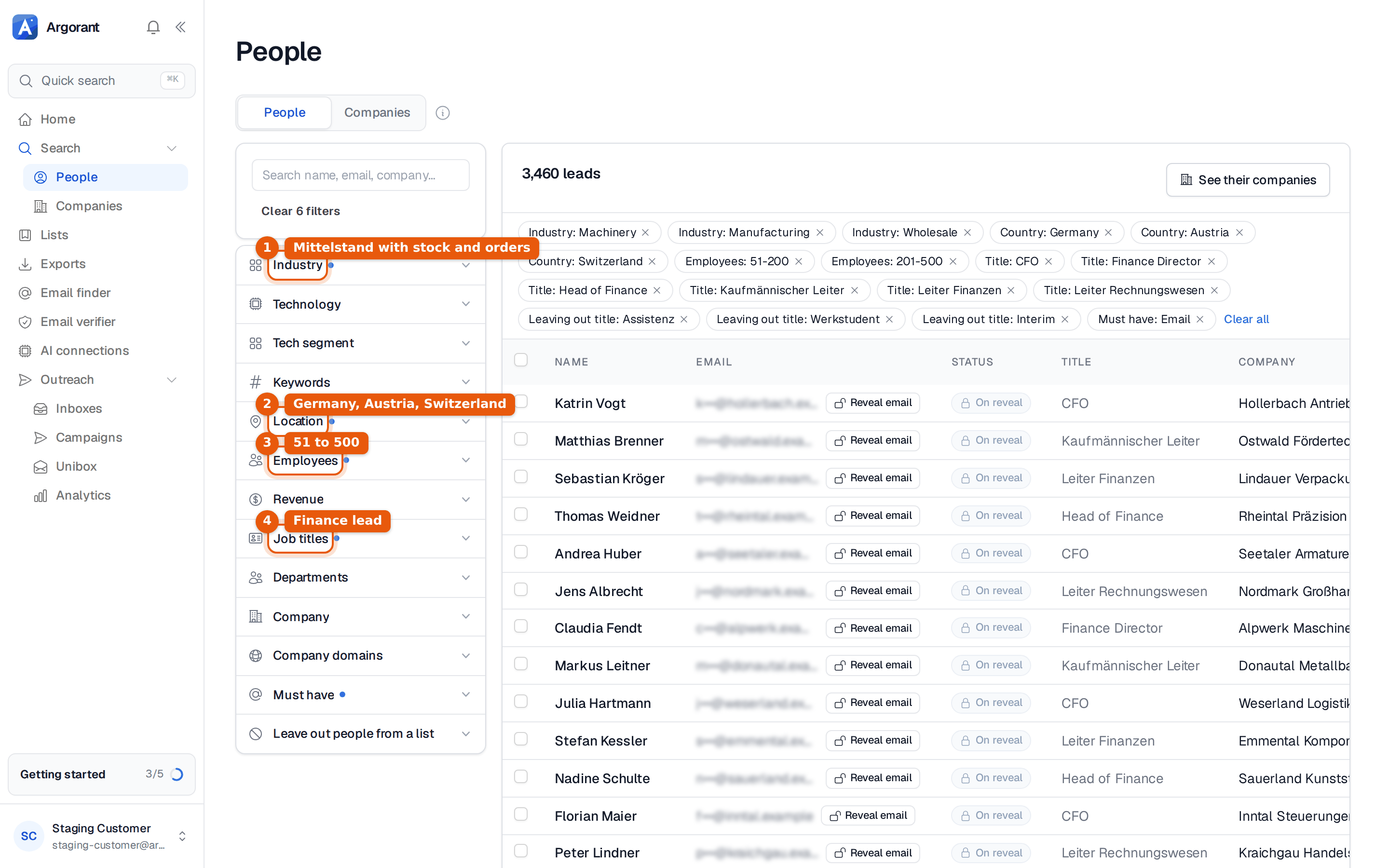
Open Search, then People. The detail that decides this list is the job titles. Half of your buyers do not call themselves CFO.
| Filter | Value | Why |
|---|---|---|
| Location | Germany, Austria, Switzerland | Add them one at a time and note each count before you combine them. The region DACH selects all three in one go once you know the split. |
| Industry | Machinery, Manufacturing, Wholesale | Stock, orders and supplier invoices, which is where a slow close hurts. |
| Employees | 51-200, 201-500 | Below 50 the close is done by the tax advisor. Above 500 there is a controlling team and a long buying process. |
| Job titles | CFO, Finance Director, Head of Finance, Kaufmännischer Leiter, Leiter Finanzen, Leiter Rechnungswesen | German titles next to the English ones. Kaufmännischer Leiter is often the real budget holder in the Mittelstand. Titles match whole words, so Leiter Finanzen does not find Leiterin Finanzen. Add the female forms too. |
| Must have | Only people you can write to. |
Assistants, working students and interim managers slip in through these titles. The link below leaves out Assistenz, Werkstudent and Interim already. They show as chips you can remove.
Step 3. Read the count, then twenty rows
Read the count once per country before you combine them. Germany will carry most of the list, Austria and Switzerland far less. That split matters for the copy, not only the volume.
- Germany and Austria can share one campaign. The German is the same and so is the formal "Sie".
- Switzerland deserves its own campaign once it is big enough. Swiss German writing uses "ss" instead of "ß", prices are in francs, and a Swiss reader notices a German email immediately.
- If the combined count is above 15,000, a filter did not apply. Usually the industries are missing.
- If it is under 1,000, add the female title forms, Leiterin Finanzen and Kaufmännische Leiterin, and Leiter Controlling.
Then scroll twenty rows. Accountants without budget, payroll clerks and tax advisors who sit on a board look similar in a title list. If more than two or three per twenty are not finance leads, tighten the titles before you write a word.
Step 4. Save the list, keep only valid emails
Click Select matching, pick how many people you want, then Save list. A name that survives is DACH - Machinery, mfg, wholesale 51-500 - CFO and KL.
When you attach it to a campaign, include Valid only. Each person from search costs 1 credit unless you unlocked them before. In Germany and Austria, the rules for unsolicited business email are stricter than in the US. Check with your own counsel what applies to you, keep every email clearly about the reader's job, and stop at once when someone asks.
Step 5. One line about their setup
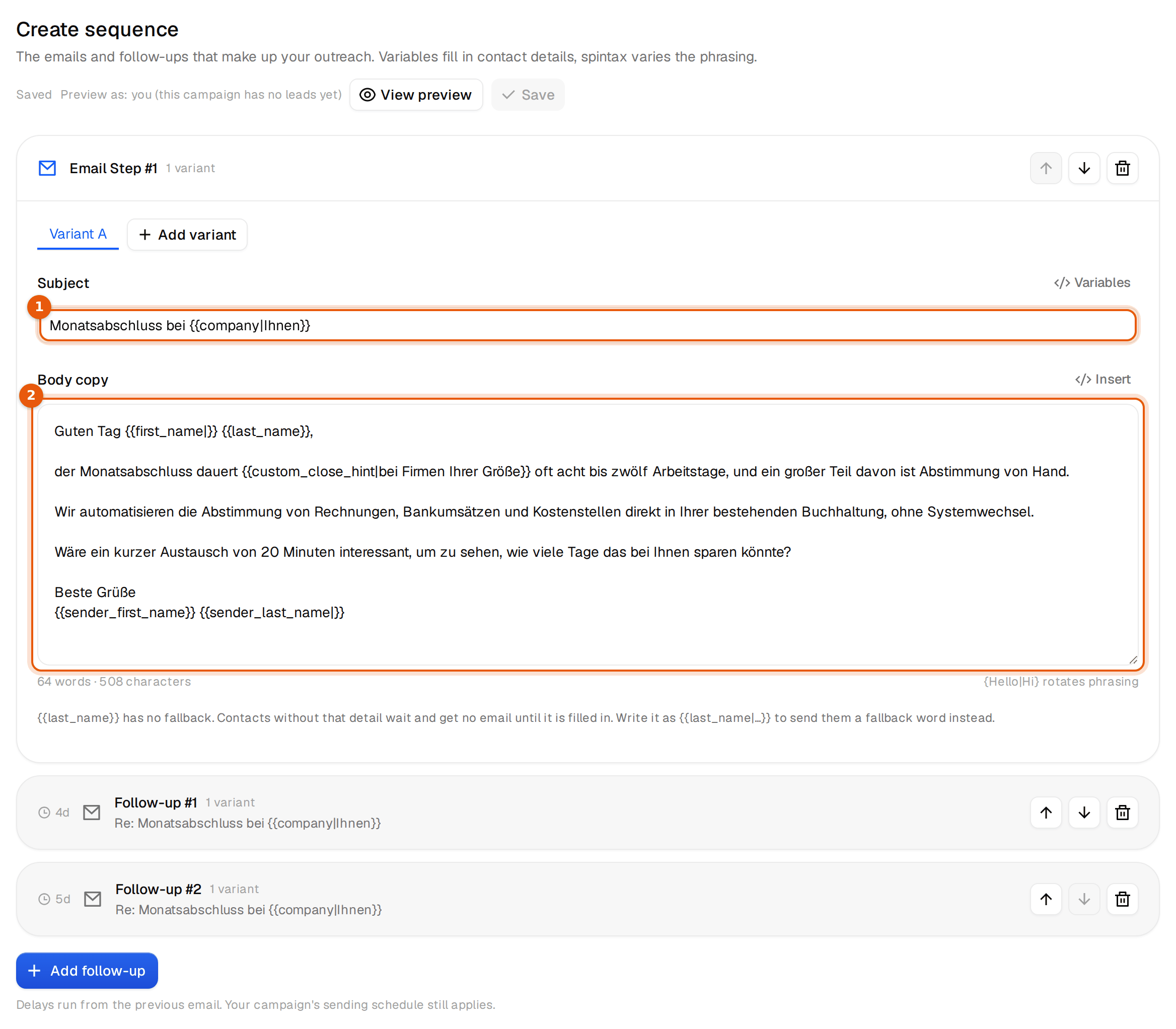
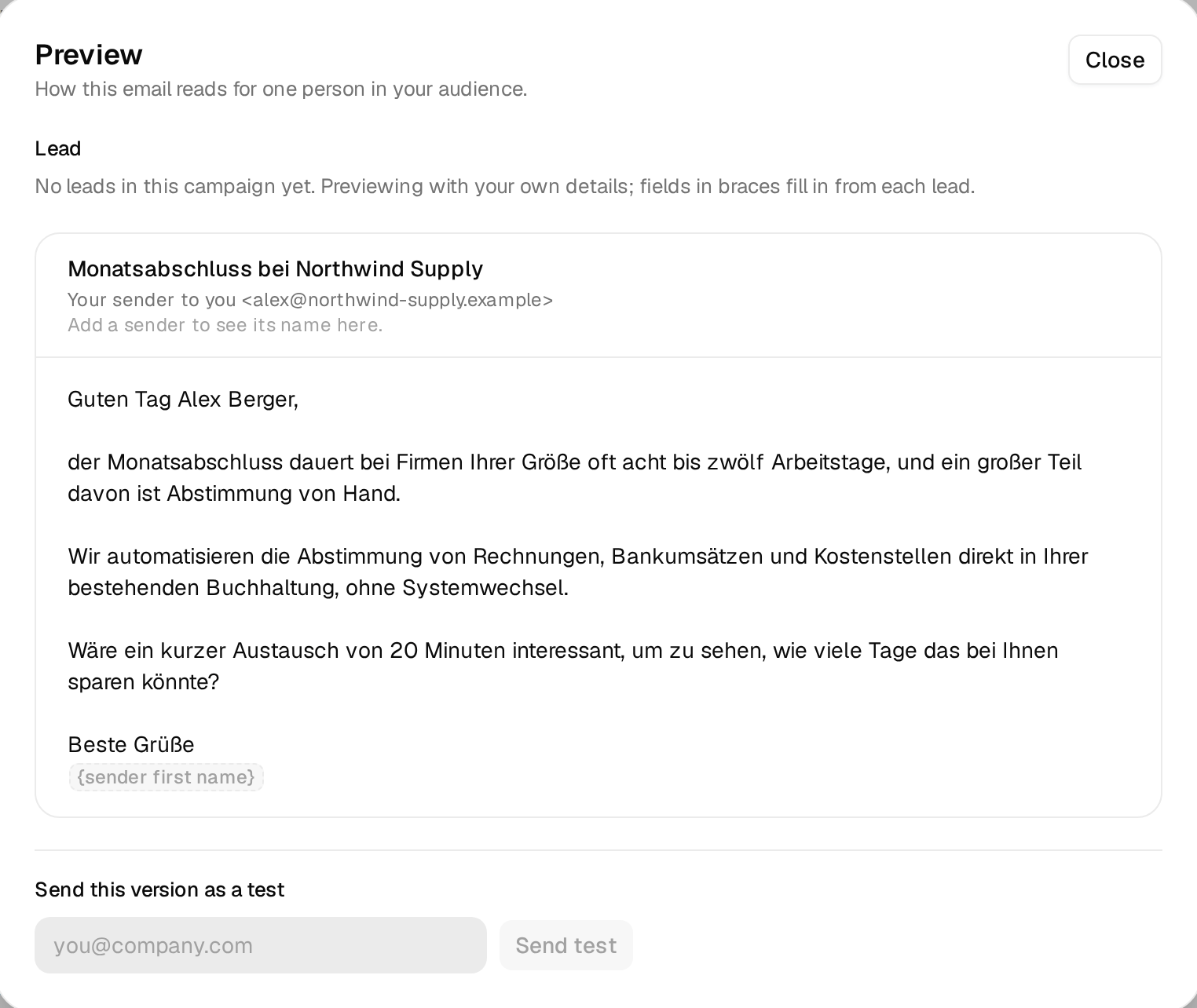
A finance lead reads the first two lines and decides. The line that earns the third is about their company, not your product. It goes into {{custom_close_hint}} and sits inside this sentence of the first email, "der Monatsabschluss dauert [line] oft acht bis zwölf Arbeitstage". Replace eight to twelve with what you actually see at your customers.
The facts come from the company's own website. Number of sites, foreign subsidiaries, own logistics, a large supplier base. Fill the line from a file you upload with Upload CSV, or let Claude or ChatGPT read each website and write it. It shows you five examples first and keeps the fallback where it found nothing.
For my campaign "Demo: DACH CFOs 51-500", set up a personal line called custom_close_hint.
Write it in German. It says what makes this company's month-end close complex, from its own website:
sites, subsidiaries abroad, own logistics, many suppliers. 4 to 10 words, starting with "bei" or "mit",
e.g. "bei drei Standorten und eigener Ersatzteillogistik".
Fallback: "bei Firmen Ihrer Größe".
Show me five examples with the source first. Never guess a number.| Company | Personal line | How the sentence reads |
|---|---|---|
| Hollerbach Antriebstechnik | bei drei Standorten und eigener Ersatzteillogistik | der Monatsabschluss dauert bei drei Standorten und eigener Ersatzteillogistik oft acht bis zwölf Arbeitstage |
| Nordmark Großhandel | bei mehreren tausend Lieferantenrechnungen im Monat | der Monatsabschluss dauert bei mehreren tausend Lieferantenrechnungen im Monat oft acht bis zwölf Arbeitstage |
| Seetaler Armaturen | mit Gesellschaften in der Schweiz und in Deutschland | der Monatsabschluss dauert mit Gesellschaften in der Schweiz und in Deutschland oft acht bis zwölf Arbeitstage |
| No line of its own | bei Firmen Ihrer Größe | der Monatsabschluss dauert bei Firmen Ihrer Größe oft acht bis zwölf Arbeitstage |
Step 6. The three emails, in German
Press New campaign, attach the list and open Emails. The emails are in German with "Sie", because your readers are. The greeting uses first and last name, the common form in German business email when you do not know the reader. {{first_name|}} has an empty fallback on purpose. Without it, a missing first name would print the English word "there". Last name has no fallback, so a contact without one waits instead of getting a broken greeting.
In English, roughly. The close at companies like yours often takes eight to twelve working days, mostly manual reconciliation. We automate that inside your current accounting system, no migration. Worth 20 minutes to see how many days it would save you?
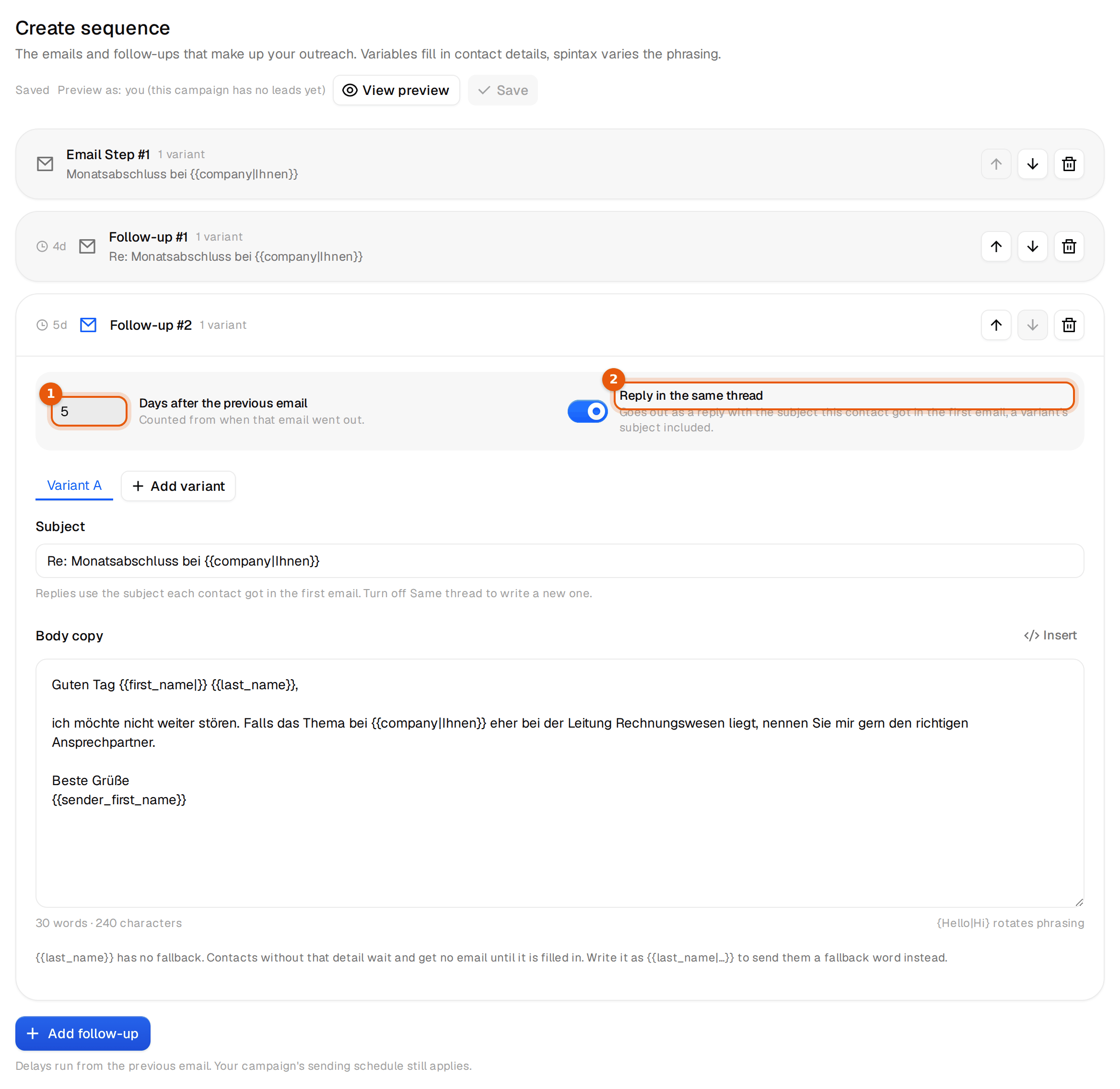
The gist. Most finance teams lose the time searching, not booking, for missing receipts and open items. Happy to show on a sample month what reconciles itself.
The gist. I will not keep writing. If this sits with the head of accounting, who is the right person?
Step 7. Mailboxes for 2,500 people in 5 weeks
Cold email never goes out from your main domain. It goes out from separate mailboxes on domains that look like yours, for example a short variation of your brand name. If one of them gets tired, you retire it and your real domain never notices.
Here is the math for this campaign. 2,500 people over 5 weeks is about 100 new people per weekday. Each gets three emails, so once the follow-ups overlap you send roughly 300 emails a day. At 5 cold emails per mailbox per day, that is about 60 mailboxes.
| Input | Value |
|---|---|
| New people per weekday | 100 |
| Emails per person | 3 |
| Emails per day once everything runs | about 300 |
| Cold emails per mailbox per day | 5 |
| Mailboxes | about 60 |
There are two ways to get there. Under Outreach, Inboxes you connect mailboxes you already have, from Google, Microsoft or any other provider. Or you have new Microsoft 365 mailboxes set up on new domains. Those come in bundles from 100 mailboxes, you do not need a plan to buy them, and they connect to your campaigns on their own. 100 mailboxes carry 500 cold emails a day, which leaves room for a second campaign.
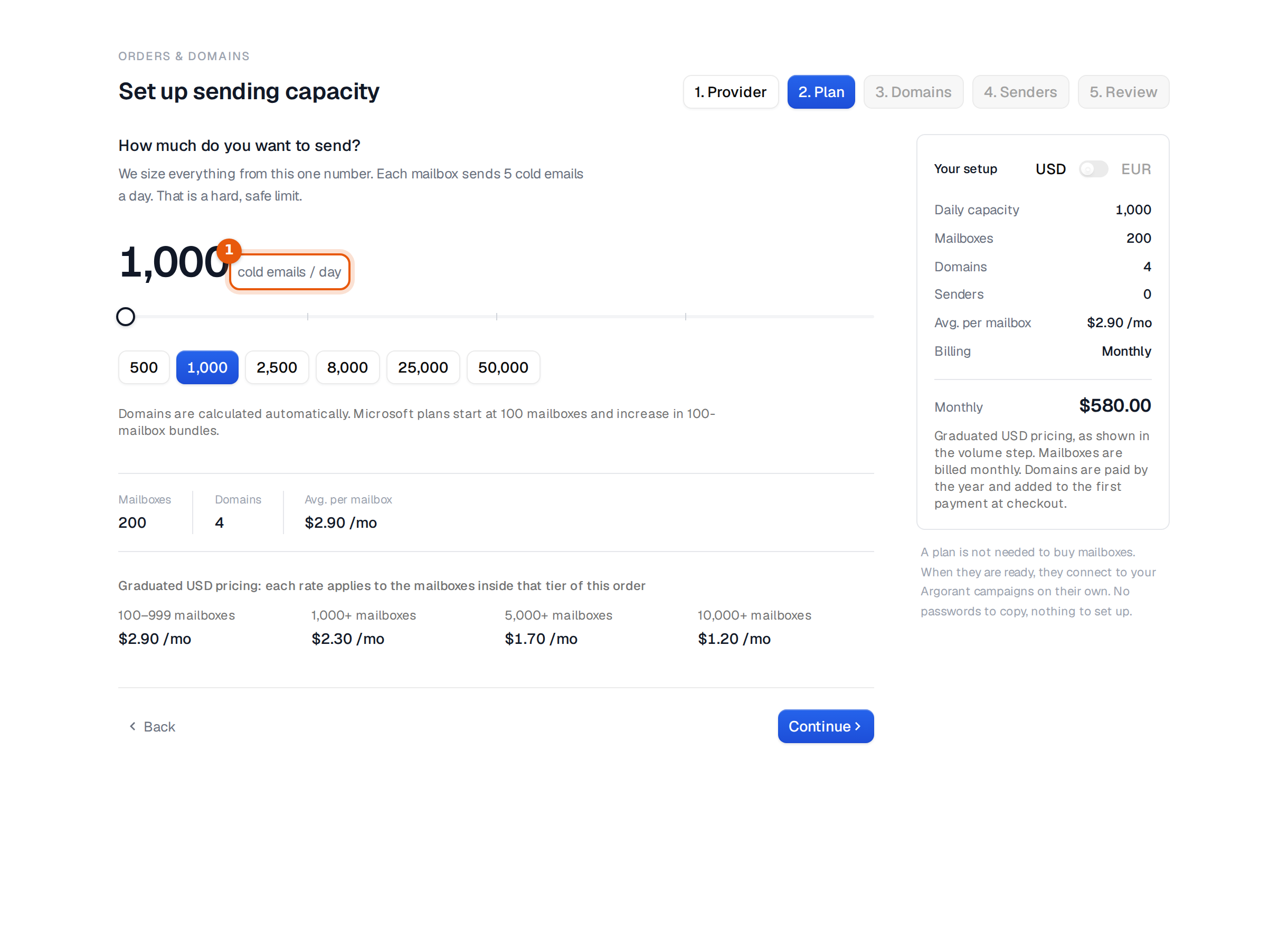
New mailboxes wait at least 24 hours before they send anything. Warm-up is included and starts switched off. Switch it on for new mailboxes and give them one to two weeks before full volume. Never raise the limit per mailbox to go faster. More mailboxes is the right lever.
For German readers, the sending domain and the sender name matter more than in the US. A .de domain and a real German name in the signature read as a person. Set {{sender_last_name}} on each mailbox, because the first email signs with first and last name.
Step 8. Schedule and launch
In the Senders step of the wizard, every connected mailbox is ticked. Untick the ones that belong to other campaigns or brands. Sends rotate across the ones you keep, and each one still respects its own daily limit.
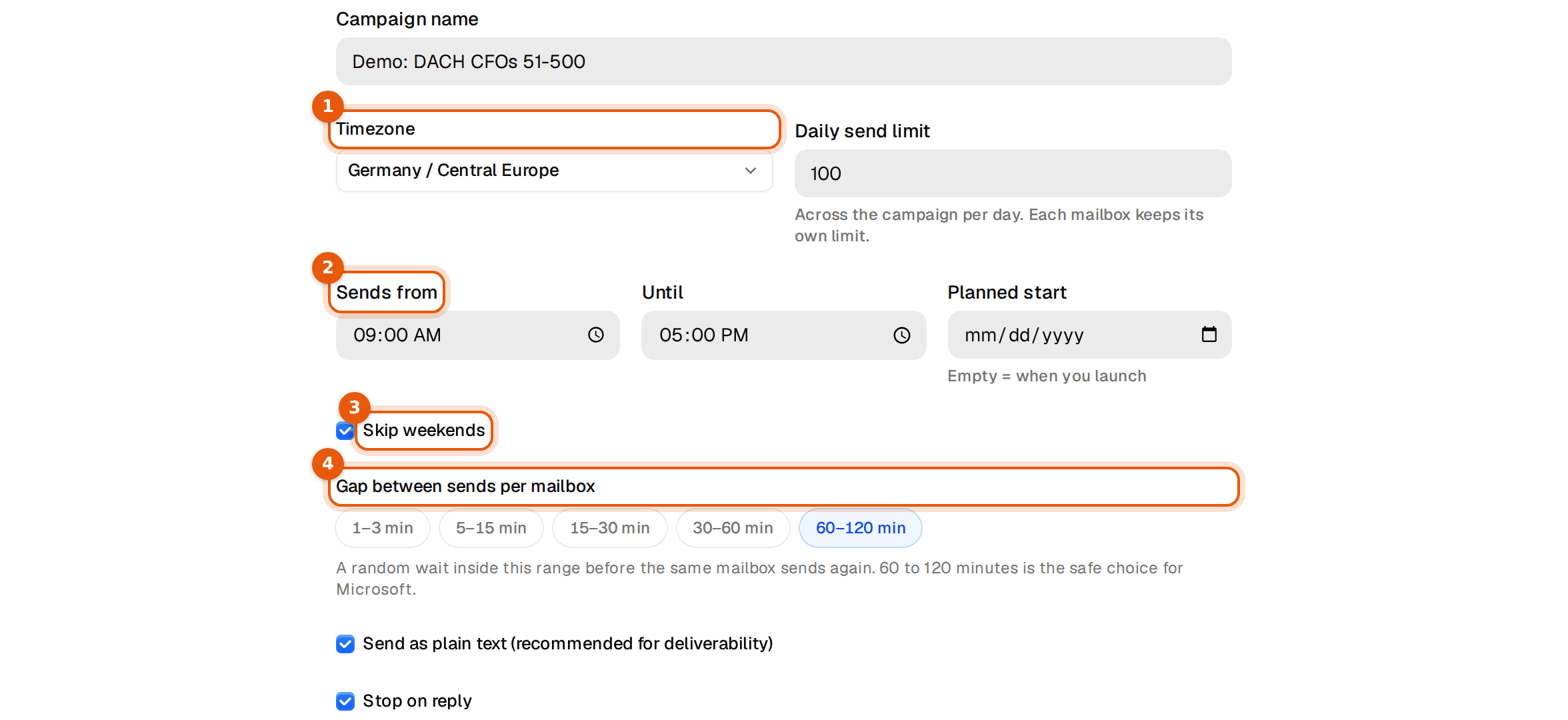
In the Schedule step, set the timezone of the people you write to, here Germany / Central Europe, not your own. Keep the sending window at 09:00 to 17:00, keep Skip weekends on and keep the gap between sends per mailbox at 60 to 120 minutes. Plain text stays on, so the email looks like it came from a person and carries no tracking pixel.
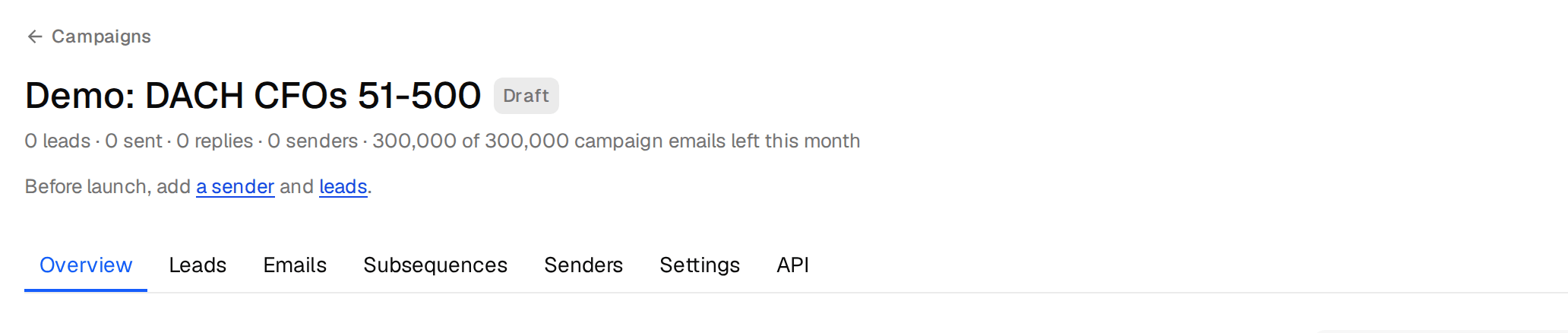
The last step is the review. Read it as if somebody else built the campaign. The audience with the grades you picked, the sequence with its waits, the senders, the start and the pace. Then press Launch campaign. Launch is not possible without senders and leads, and mailboxes still in their first day hold the launch until they are ready. Afterwards, open the Settings tab and check that Stop on reply and Bounce protection are on. Bounce protection pauses the campaign when more than 10% bounce once 100 people have been contacted.
Step 9. Replies and booked calls
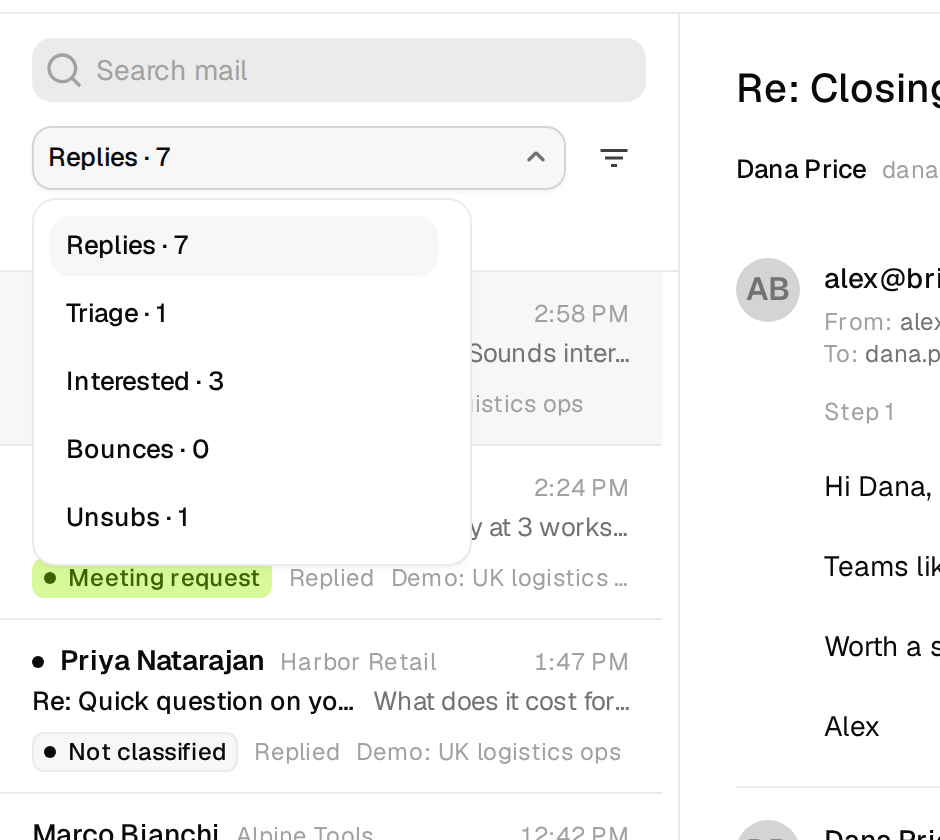
Every reply lands in the Unibox, from every mailbox and campaign, and gets a label on its own. The standard labels are Interested, Meeting request, Out of office, Unsubscribe and Other. Switch on Referral and Wrong person in the settings as well. On our own largest campaign, one in four human replies pointed us to a colleague, more often than a straight yes.
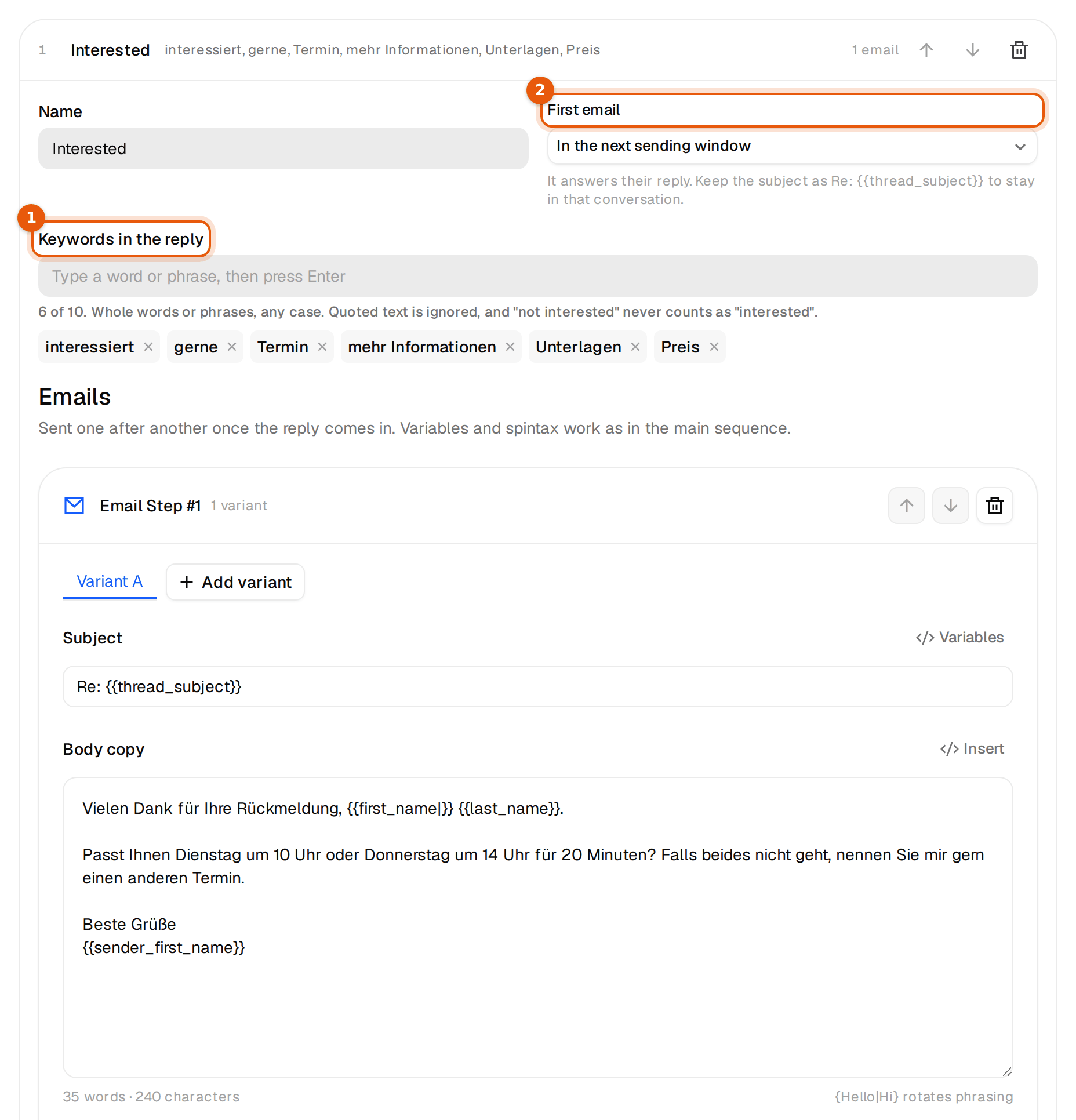
A yes gets answered by the campaign itself, with a subsequence. It starts when a reply contains one of your keywords, takes the person out of the main sequence and answers in the same thread in the next sending window. A reply that says "not interested" or asks you to stop never triggers one.
On the Subsequences tab, add one with German keywords. interessiert, gerne, Termin, mehr Informationen, Unterlagen, Preis. Keywords match whole words and phrases in any case, and "not interested" never counts as interested. A German "kein Interesse" is a different phrase, so read the matches in the first week and remove a keyword that fires on the wrong replies.
The gist. Thank you for your reply. Does Tuesday at 10 or Thursday at 2 work for 20 minutes? If neither does, just name another time.
Every morning, filter the Unibox by Meeting request and Interested. Those are the conversations one answer away from a call. Propose a specific time instead of just a link, and add your booking link as the second option. When the call is set, change the label to Meeting booked so your numbers count it. Answer referrals the same day. Thank them, write to the person they named, and mention who sent you.
If you would rather work from Claude or ChatGPT, your assistant can read the Unibox, sort replies by label and draft answers. Nothing is sent until you confirm. The use case Run it all from Claude or ChatGPT shows how.
What to expect
The ranges below come from our own sending, scaled to 2,500 people. Our healthy campaign, two emails to a valid-only list from mailboxes at 5 cold emails a day, got human replies from 1.3% of the people contacted. Campaigns from overworked mailboxes sat at 0.3%. About one in five human replies says yes, and about one in four points you to a colleague. These are reference points, not promises. Your offer, your segment and your copy move them a lot. The reply rate in Argorant also counts out-of-office notes, so it reads higher. Compare these numbers with the reply rate excl. OOO.
| Number | For 2,500 people |
|---|---|
| Human replies (0.3 to 1.3%) | 8 to 33 |
| Of those, interested | 2 to 7 |
| Referrals to the right person | 2 to 9 |
| Bounces with valid-only addresses | under 1% |
| Booked calls if you answer the same day | 3 to 10 |
Finance leads in the Mittelstand answer less often than operations people, and they answer carefully. A typical yes reads like a question about the integration with their accounting system. Have a one-line answer ready for the systems your product works with, because that reply decides the call.
On the calendar it looks like this. The first replies arrive in week one, 65% of all replies come within an hour of the email landing and 84% answer the first email. After 5 weeks everyone has had the full sequence, and a week later nearly everything that will come is in. If human replies stay near zero after a few hundred people, check delivery first and copy second.
| Country | What changes |
|---|---|
| Germany | The bulk of the list. Formal Sie, .de sending domains. |
| Austria | Same copy works. Read twenty Austrian rows on their own, titles there can differ slightly from Germany. |
| Switzerland | Separate campaign once large enough. Write ss instead of ß and use francs. |
Do the same from Claude or ChatGPT
Connected to Argorant, your assistant builds the same list from one request and asks before it spends a credit.
The full setup is in Run it all from Claude or ChatGPT.

 ChatGPT
 Using Argorant