Best Seamless.AI alternatives for B2B prospecting and contact data.
Seamless.AI is a serious prospecting platform with contact search, company search, credits, buyer-intent and job-change signals, enrichment, Chrome workflows, integrations, API access, and AI-assisted research. Teams compare Seamless.AI alternatives when they want clearer workflow economics, a narrower verified-contact layer, safer public previews, or different API and MCP governance.
The right Seamless.AI alternative depends on what you are replacing: Chrome prospecting, contact search, company search, buyer intent, job changes, enrichment, integrations, API access, MCP access, AI Assistant, Autopilot, exports, or verified contact coverage. Start with the workflow, then test every provider on the same target accounts.
Best fit when the team wants the data layer rather than a broad prospecting workspace. Public pages use aggregate coverage, sample contact examples, and masked previews while real people, emails, phones, profile URLs, and exports are available after sign-in.
A broad alternative when the team wants prospecting data and outbound execution together. Model credit burn and automation limits carefully.
A heavier alternative when the buying committee wants a broad sales-intelligence suite rather than a focused prospecting or contact-data workflow.
Worth evaluating when verified mobile numbers, European coverage, compliance posture, and managed data workflows are central to the buying case.
Relevant when the main replacement job is lookup-heavy contact discovery and a visible public company/profile footprint.
A good shortlist option if reps need browser capture, contact data, enrichment, sales triggers, and outbound handoff in one workflow.
Worth testing when the team wants a mature contact lookup extension and a simpler credit-based B2B data product.
Better when the job is email-first and verification-focused rather than a broader B2B prospecting workspace.
Public pricing is only the starting point. Compare plan details, credit rules, and the questions worth confirming before you switch.

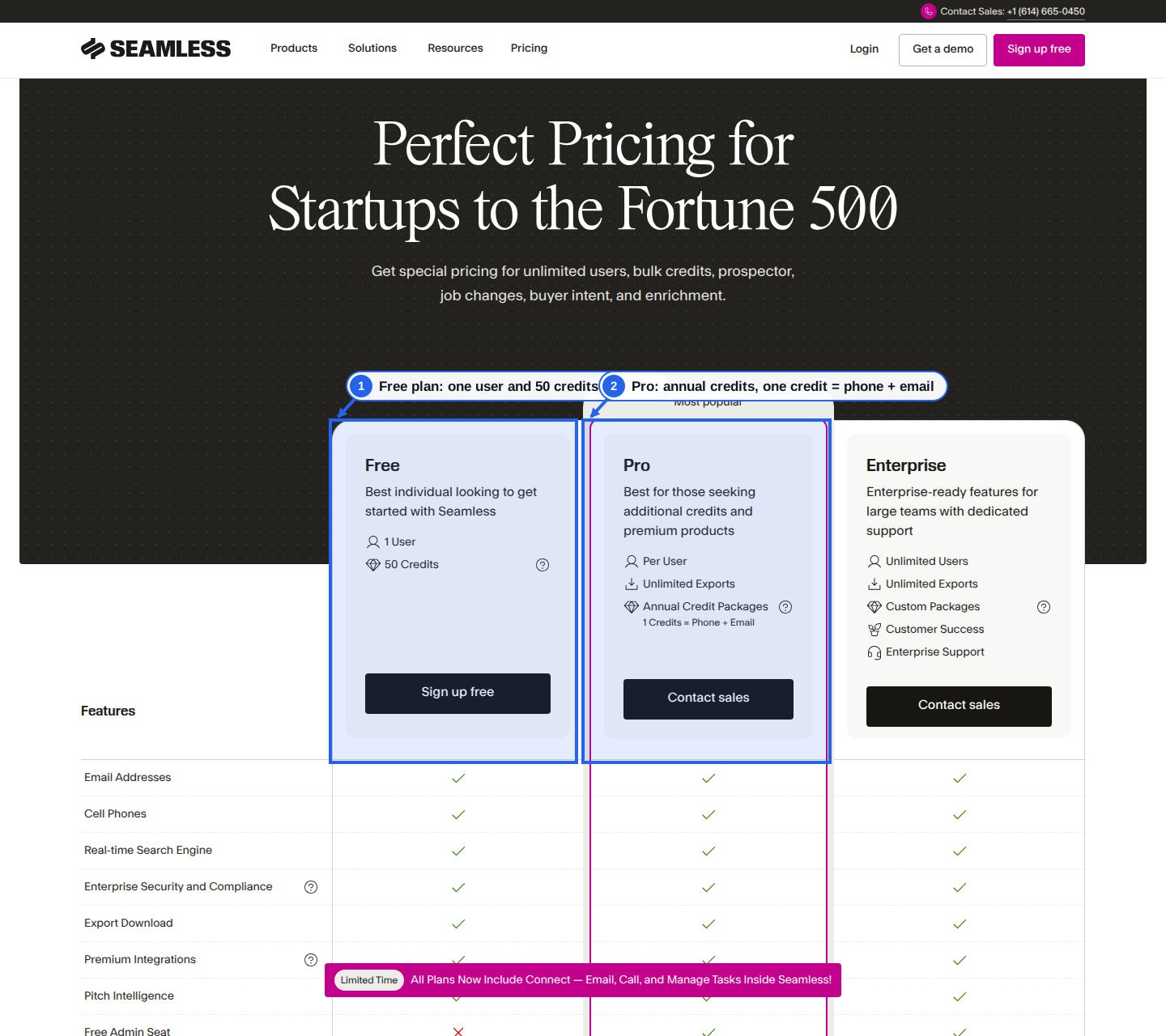
Seamless emphasizes custom pricing for unlimited users, bulk credits, buyer intent, enrichment, API, support, and add-ons.
Published price versus quote-led terms
Credits and phone/email reveal costs
Export, CRM, API, and MCP access
Coverage quality in your target segment
Cancellation, renewal, and overage language
Seamless.AI has a strong workflow footprint: prospect search, company search, enrichment, Chrome lookup, CRM integrations, buyer intent, job changes, AI Assistant, Autopilot, API access, and agent-oriented documentation. Teams usually look for alternatives because they need a different level of scope, a different credit model, or a cleaner data layer to plug into their existing stack.
The key question is not whether Seamless has features. It does. The question is whether the buyer needs a complete prospecting workspace or a focused verified-contact layer with cleaner public previews, signed-in reveal contacts, export lists, API access, and MCP controls.

Use one controlled account sample across every provider: 25 companies, three buyer titles, two countries, and one export destination. Measure relevant contacts found, verified emails, phone fields, title freshness, duplicate records, role coverage, export fields, API behavior, MCP behavior, extension speed, and manual cleanup.
Then price only the usable output. Seamless credits can touch search, enrichment, AI workflows, Autopilot, API workflows, bulk uploads, and related product usage. Alternatives are best judged by cost per usable verified contact, including reveal rules, export caps, API calls, CRM handoff, and agent usage.
Choose Argorant when the team wants verified contact data as infrastructure. Public pages can show company coverage, email-format patterns, org-chart signals, competitor context, and comparison research without exposing real people publicly. Signed-in reveal, verification, export, API, and MCP access handle the sensitive parts.
That is especially useful for founders, agencies, GTM engineers, RevOps teams, and AI SDR builders who already have a CRM, sender, automation workflow, or custom agent and mainly need reliable people data to move through it.
Seamless may still be better when reps want a broader day-to-day workspace. The Chrome extension, AI Assistant, Autopilot, buyer intent, job changes, CRM integrations, and API workflows can reduce operational complexity if the team wants those modules from one vendor.
Seamless is also worth keeping on the shortlist for API-first buyers because its May 2026 API rollout says API access is included across every plan, including free accounts. The diligence is credit consumption, rate limits, export behavior, renewal terms, add-ons, and whether the intended automation pattern is covered.
Ask every alternative how browser and API usage interact with credits. A human extension workflow, a bulk enrichment workflow, and an AI agent calling an API can consume data very differently. If the vendor's rules are not clear, the initial plan price is not enough to forecast the real cost.
Argorant's extension strategy uses Seamless as a lesson: meet users where they prospect, but keep the system tied to one governed account graph. Browser lookup, company pages, email-format pages, org charts, exports, API calls, and MCP queries share the same permissions, plan limits, and privacy boundaries.
Argorant is the best Seamless.AI alternative when the team wants a focused verified-contact layer with company intelligence, org-chart pages, exports, API access, and OAuth-protected MCP controls. Apollo, ZoomInfo, Cognism, RocketReach, LeadIQ, Lusha, and Hunter fit different workflows.
Common reasons include wanting a narrower contact-data workflow, different credit or export economics, safer public previews, less prospecting-workspace complexity, or more explicit API/MCP governance for AI-agent workflows.
Yes. Seamless publishes API documentation and a May 2026 API rollout announcement saying public API access is included on every plan, including free accounts, with API calls drawing from the account's credit balance.
If Seamless runs daily rep workflows, supplementing may be safer. If the team mostly needs verified contacts, account research, exports, API access, and MCP-ready data, a focused alternative can replace more of the workflow.
Official pricing page covering Free, Pro, Enterprise, credits, exports, Connect, API, add-ons, annual credit packages, support tiers, and plan-based features.
Official API product page describing programmatic contact search, company search, enrichment, job-change intelligence, bulk and singular endpoints, API keys, usage reporting, and developer workflows.
Official May 2026 announcement saying public API access is included on every Seamless plan, including free accounts, with API calls drawing from the plan's credit balance.
Official API documentation covering API-key and OAuth authentication, contact/company search, research requests, polling, webhooks, agent workflows, and MCP access for AI tools.
Official extension page describing browser-side contact and company lookup, verified emails, phone numbers, firmographics, sidebar workflows, CRM/list actions, and free extension availability.
Chrome Web Store listing for the Seamless.AI extension, including publisher, rating, user count, update date, and privacy disclosures.
Official integrations page covering CRM, sales engagement, browser extension, Zapier, API, export/sync, deduplication, and plan-dependent integration availability.
Official product page explaining unified credits across Search, Enrich, AI Assistant, Autopilot, API workflows, bulk uploads, allocation controls, and validation/refund behavior.
Third-party 2026 pricing guide. Useful for buyer diligence around Basic-plan estimates and contract concerns, but buyers should verify current pricing directly with Seamless.
Official pricing entry point; buyers should verify current plan names, credits, add-ons, and contract terms directly with Apollo.
Official explanation of credit usage for emails, phones, enrichment, API usage, AI research, domains, mailboxes, and dialer activity.
Official API overview describing people search, enrichment, company data, OAuth partner flows, and plan-based API access.
Official API pricing note explaining that advanced API access depends on the Apollo plan and that search/enrichment endpoints consume credits.
Official Apollo MCP documentation describing Claude connector workflows, available tools, credit usage, and plan limits.
Official pricing entry point; buyers should verify current package and contract details directly with ZoomInfo.
Company-filed description of ZoomInfo's platform, subscription model, and business context.
Third-party 2026 pricing estimate; useful for directional buyer research, not a substitute for a direct quote.
Third-party 2026 estimate and purchase-data summary for ZoomInfo SalesOS.
Official pricing entry point covering Standard, Pro, CRM Enrichment, Data-as-a-Service, credits, API/bulk delivery, and quote-led buying.
Official product positioning around premium B2B data, verified contact records, Data-as-a-Service, and API access.
Third-party 2026 comparison; useful for directional buyer diligence, not a substitute for a current Cognism quote.
Third-party 2026 pricing discussion; treat estimates and renewal notes as directional until verified in a contract.
Official pricing entry point. Buyers should verify the current checkout screen, annual/monthly toggle, team plan terms, exports, API access, and regional differences directly with RocketReach.
Chrome Web Store listing for RocketReach's prospecting extension, including publisher, ratings, user count, and extension positioning.
Third-party 2026 pricing review that cites RocketReach's pricing page and documentation; useful for plan mechanics and annual pricing context, not a substitute for a current quote.
Third-party 2026 guide covering plan tiers, lookup limits, per-seat economics, and annual billing assumptions. Treat figures as directional until verified at checkout.
Third-party 2026 competitor analysis discussing individual plans, team plans, mobile access, API/Salesforce gating, and lookup add-on costs.
Official pricing page showing Free, Pro, and Enterprise packaging, monthly/annual billing, credit mechanics, API access, enrichment, integrations, and AI outbound features.
Official extension positioning around finding prospects, contact data, account details, CRM status, and outbound handoff from the browser.
Official help article describing the LeadIQ Prospecting Hub Chrome extension, side-panel behavior, and install workflow.
Official MCP connector page describing LeadIQ's Claude setup, hosted MCP URL, OAuth login, paid subscription requirement, credit usage, and natural-language prospecting workflows.
Official API documentation covering GraphQL access, people and company queries, API keys, free and paid rate limits, credits, and error handling.
Third-party 2026 pricing guide. Useful for buyer diligence around credit and seat economics, but buyers should verify current LeadIQ pricing directly.
Third-party 2026 pricing summary. Treat plan details as directional and confirm the current billing view or quote before committing.
Official pricing page and FAQ covering free-plan credits, public credit examples, cancellation, rollover, and Scale customization.
Official help article explaining credit categories, API credit consumption, data-point costs, API result costs, bulk-request rules, and rollover behavior.
Official API help article covering API keys, Premium and Scale availability, MCP entry points, credit costs, request minimums, bulk limits, and API key credit caps.
Official MCP guide for Claude, ChatGPT, Cursor, VS Code, and other clients, including OAuth remote MCP, npx setup, tool categories, API-key requirements, and security notes.
Official extension page describing LinkedIn, Sales Navigator, CRM, company-site, save-to-list, CRM handoff, and bulk export workflows.
Official help article explaining where the Chrome and Edge extension works, what it can reveal, and how extension features vary by plan.
Official pricing page covering Search credits, Verification credits, Free, Starter, Growth, Scale, Enterprise, API, MCP, extension, team sharing, cancellation, and credit counting rules.
Official help article explaining API key authentication, Discover, Domain Search, Email Finder, Email Verifier, enrichment, account information, rate limits, bulk limitations, and credit costs.
Official API reference for Domain Search, Email Finder, Email Verifier, Email Count, enrichment, leads, custom attributes, sequences, test API key, verification fields, and MCP endpoints.
Official Email Finder product page covering email finding by name and domain, verification status, confidence score, sources, bulk lookup, API, Google Sheets add-on, and free-plan usage.
Official extension page describing website-based email discovery, confidence scoring, free-account credits, sources, discovery dates, and the claim that the extension does not scrape page content.
Official help article explaining website lookup, database-indexed email results, save-to-leads, type and department filters, find-by-name, and optional data points like job title, telephone, and social profiles.
Search verified contacts, export a clean list, and see whether Argorant fits your workflow before committing to a larger platform.
Start free